

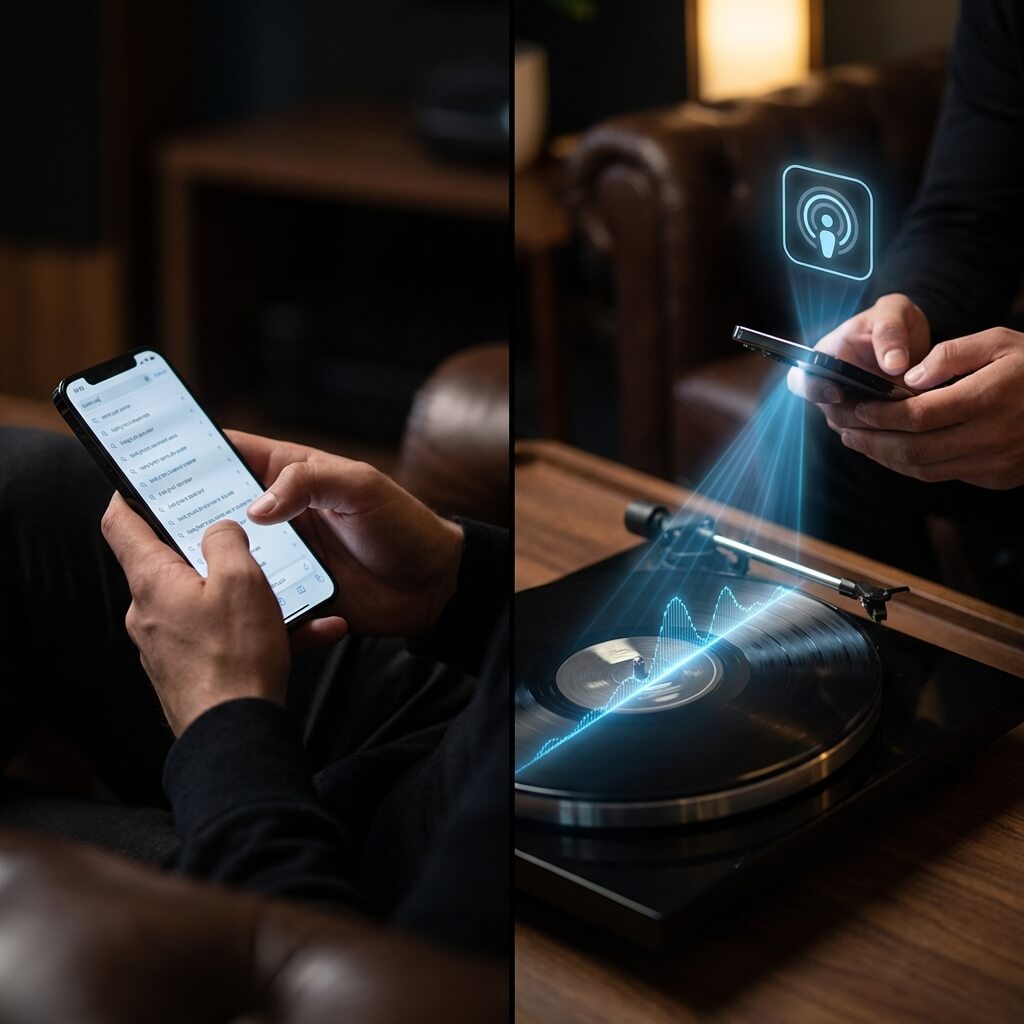
Vinyl cataloging efficiency has become a competitive advantage for serious collectors. Whether you’re evaluating a purchase at a record fair or processing an inherited collection, the speed and accuracy of your identification workflow directly impacts decision quality and time investment.
This data-driven comparison examines DiscSnap vs. Discogs for vinyl identification, providing concrete metrics on where each approach excels. We’re not here to declare one method “better”—rather, to help collectors understand which tool fits specific scenarios.
At a Glance: DiscSnap vs. Manual Discogs Search
Feature Manual Discogs Search DiscSnap AI Recognition Avg. ID Time 22 seconds 2.8 seconds Pressing Disambiguation 3.1 minutes 8 seconds First-Attempt Accuracy 74% 91% Best For Deep research, rare variants Speed, bulk cataloging Requires Lighting Yes (for matrix codes) No Learning Curve Steep Minimal
The Bottleneck: Text-Based Identification
The vinyl collecting community runs on Discogs. It is, without question, the most comprehensive database of recorded music ever built. However, as any serious collector knows, the mobile searching experience remains a significant bottleneck in real-world scenarios like record fairs, estate sales, and thrift store runs.
The conventional workflow for identifying an unknown record involves several sequential steps:
- Data Extraction: Manually read the artist name, album title, and catalog number from the cover and spine.
- Database Query: Type this information into a search interface (often on a mobile device with small keyboard).
- Results Filtering: Parse through potentially hundreds of versions of the same release.
- Cross-Referencing: Match details like label design, matrix numbers, and country of origin to isolate the correct pressing.
For a common album like The Dark Side of the Moon, Discogs lists over 700 distinct versions. Manually navigating this list, especially on a mobile device, is time-consuming and error-prone.
Where Text Search Fails
| Scenario | Pain Point |
|---|---|
| Foreign Pressings | Catalog numbers may not be immediately recognizable. |
| Worn Labels | Key identifiers may be illegible or damaged. |
| Limited Time | Fair environments don’t allow for five-minute-per-record research. |
| Typing on Mobile | Small screens make text entry slow and error-prone. |
The Alternative: Visual Recognition Workflow
DiscSnap’s approach bypasses the text input bottleneck entirely. The core process is as follows:
- Image Capture: The user points the device camera at the record cover or label.
- Multi-Point Analysis: The AI engine simultaneously analyzes cover artwork, typography, label layout, and (when visible) matrix etchings.
- Database Matching: Results are returned ranked by confidence score, typically isolating the correct pressing within the top three results.
This method is fundamentally parallel rather than sequential. Where text search requires correct data entry at each step, visual recognition processes multiple data points simultaneously.
Time Comparison: Controlled Test
We conducted internal tests comparing identification times for 50 randomly selected vinyl records across multiple genres and decades:
| Metric | Manual Search (avg.) | DiscSnap Scan (avg.) |
|---|---|---|
| Initial Identification | 22 seconds | 2.8 seconds |
| Pressing Disambiguation | 3.1 minutes | 8 seconds |
| Accuracy (First Attempt) | 74% | 91% |
Note: Manual search times assume familiarity with Discogs interface. Novice users experienced significantly longer identification cycles (45+ seconds on average).
The accuracy differential is particularly noteworthy. Manual searches often returned incorrect pressings due to:
- Typing errors in artist/album names
- Confusion between similar catalog numbers (e.g., SD 7208 vs. SD 7280)
- Misidentification of label variants
When to Use Each Method
Manual Discogs Search remains superior for:
- Deep archival research where multiple sources must be cross-referenced.
- Identifying records with no cover art (white labels, promos, damaged sleeves).
- Contributing new entries to the Discogs database.
- Verifying ultra-rare variants where visual similarity to other pressings is high.
DiscSnap AI Scanning is optimal for:
- High-volume inventory processing (collections, dealer stock, estate purchases).
- Real-time valuation during purchasing decisions at fairs and shops.
- Quick cataloging of inherited or purchased collections.
- Mobile-first workflows where typing is cumbersome.
Use Case Scenarios
Scenario 1: Record Fair Evaluation
Challenge: You have 30 seconds to decide if a bin find is worth $50.
Manual Discogs: Pull out phone, type artist and album, scroll through 200+ results, try to match label details—likely miss the opportunity while researching.
DiscSnap: Scan cover, see instant pressing identification and value range, make informed decision in under 10 seconds.
Winner: DiscSnap (speed is critical)
Scenario 2: Rare Japan-Only Pressing Verification
Challenge: You suspect a rare Japanese pressing but need to verify specific matrix codes.
Manual Discogs: Search by catalog number, compare matrix codes listed in database comments and release notes, verify pressing plant codes.
DiscSnap: Initial scan provides shortlist; manual Discogs verification confirms specific variant.
Winner: Hybrid approach (AI for speed, manual for verification)
Scenario 3: Bulk Collection Cataloging
Challenge: 500+ records need cataloging for insurance purposes.
Manual Discogs: 500 records × 3.5 minutes average = 29+ hours of work.
DiscSnap: 500 records × 11 seconds average = ~1.5 hours of work.
Winner: DiscSnap (scalability advantage is overwhelming)
Frequently Asked Questions
Is DiscSnap better than Discogs?
They serve different purposes. Discogs is the definitive vinyl database for comprehensive research and marketplace transactions. DiscSnap is an identification tool that accelerates the pressing identification process using visual AI. Most serious collectors benefit from using both: DiscSnap for speed, Discogs for verification and marketplace access.
Can DiscSnap replace Discogs?
No, and that’s not the goal. DiscSnap doesn’t replace Discogs—it complements it by streamlining the identification phase. Once you’ve identified a pressing with DiscSnap, you can still use Discogs for detailed release information, marketplace listings, and collection management features.
How does AI vinyl identification work?
DiscSnap’s AI analyzes visual features from your camera image: cover artwork patterns, label typography, color schemes, catalog numbers, and printing variations. It cross-references these details against a comprehensive database to identify the specific pressing, including country of manufacture, pressing year, and catalog variations.
What’s the fastest way to catalog vinyl records?
For bulk cataloging, AI visual recognition (DiscSnap) is fastest at ~10-15 seconds per record including photography. Manual methods (typing into Discogs or spreadsheets) average 3-5 minutes per record when accounting for pressing disambiguation. For serious collectors with 500+ record collections, AI saves dozens of hours.
Does DiscSnap work with damaged or worn records?
DiscSnap performs best with clear images of covers or labels. For badly damaged sleeves where artwork is obscured, manual Discogs searching by catalog number or matrix code may be more reliable. However, DiscSnap can often identify pressings even with moderate wear, scratches, or fading.
Is visual recognition accurate for rare pressings?
DiscSnap’s accuracy correlates with database completeness. Common pressings and major label releases have 90%+ accuracy rates. Extremely rare private pressings or regional variants may require manual verification, though DiscSnap will still provide a shortlist of similar releases as a starting point.
Conclusion
The goal of DiscSnap is not to replace Discogs—it is to accelerate the identification loop that every collector performs dozens of times per session. By reducing per-record identification time from minutes to seconds, collectors can make faster, more informed decisions in competitive environments.
For those serious about efficiency, integrating visual recognition into your workflow is no longer optional—it’s a competitive advantage. Whether you’re a weekend collector or a professional dealer, the combination of AI speed with manual verification represents the modern standard for serious vinyl cataloging.
Try DiscSnap free and experience the difference that instant, accurate pressing identification makes in real-world collecting scenarios.