
An original pressing is not automatically better sounding than a reissue, and a remaster is not automatically an upgrade. Choose the particular edition and the particular copy: its mix, mastering, condition and asking price matter more than its age or weight. For everyday listening, a clean, well-documented reissue can be the sensible purchase. For collecting a specific historical edition, an original may be worth the premium to you even when another copy plays more quietly.
The difficult part is separating those two goals. A seller’s “first press,” a 180g sticker and an impressive mastering credit answer different questions. This guide gives you a method for comparing them without pretending that one label, country or production era always wins.
Starting your first collection? The beginner vinyl collecting guide helps you check your playback setup and choose a small first shopping list before comparing collectible editions.
Original, repress, reissue, remaster: what changes?
Start by asking what “original” means in the listing. The first UK release, first US release and first Japanese release can be different editions with different cuts. An album may also have been manufactured at several plants during its original release period. “First pressing” is therefore incomplete without a territory, format and identifiable variant.
| Term | What it describes | What it does not establish |
|---|---|---|
| Original or first pressing | An edition associated with the album’s initial release in a specified market | The best sound, an unworn copy or a single worldwide pressing |
| Repress | A further production run; often associated with existing manufacturing parts | That every detail or every copy is identical |
| Reissue | A later release of an existing album | A new master, a new mix or an inferior source |
| Remaster | A new preparation of an existing mix for release | An all-analog process or a result you will prefer |
| Remix | A new balance or treatment of the recorded elements | A like-for-like comparison with the original mix |
These terms overlap. A reissue can use an earlier cut, or introduce a remaster, or feature a remix that is then mastered for vinyl. A database tag alone should not substitute for a release’s actual credits. The Discogs format guidelines provide cataloging definitions; use the edition notes and physical evidence together.
A practical question for a shop assistant is: “Is this the original mix, and do you know which mastering or cut this edition uses?” That is more useful than asking whether new vinyl is generally better than old vinyl.
What actually affects the sound?
The source and the choices made from it
The recording, mix, source used for mastering and the engineer’s decisions all contribute. Equalization can change tonal balance; compression can change how loud and quiet passages relate; the cutting level and side length can influence the compromises needed to create a playable record. None of those decisions is disclosed by the sleeve’s age.
An older edition might preserve a mastering you love. It might also have used a production copy of a tape or a different regional master. A newer edition might have access to a better source, or use restoration that you dislike. Do not turn either possibility into a rule about every original or every reissue.
If documentation says only “from the original master tapes,” distinguish the source from the complete production path. A tape can be transferred to a digital file before cutting. If an all-analog chain is important to your buying preference, look for an explicit, edition-specific statement about the cut rather than filling in missing steps yourself.
Digital is a process detail, not a listening verdict
A digital stage does not, by itself, mean a record is compressed, harsh or poorly mastered. Conversely, an analog chain does not promise low noise, careful equalization or a flawless pressing. A recording made digitally cannot become an entirely analog recording merely by being issued on vinyl.
Two primary-source examples show why disclosures are more useful than blanket assumptions:
- Blue Note’s Classic Vinyl launch announcement specifies all-analog mastering by Kevin Gray from original tapes.
- Abbey Road’s Miles Showell interview describes high-resolution digital transfers used for Rolling Stones remasters.
Those are production statements, not our comparative listening tests or endorsements of every title in either catalog. Check the exact release before applying an old series announcement to a later product.
The pressing and the individual copy
Good mastering cannot remove wear already present on the record you buy. A glossy surface may still have groove wear, especially on passages that a damaged or poorly adjusted stylus struggled to track. Visual inspection and play grading answer different questions.
New records also need inspection. Persistent tearing or zipper-like noise can indicate a pressing defect; a visibly off-center groove can cause pitch instability; a substantial warp can affect tracking. Dirt, static and playback setup can also produce audible problems, so avoid diagnosing an entire edition from one uncleaned copy on one turntable.
Use the Goldmine grading guide to separate the record’s condition from the sleeve’s condition. Ask whether the seller inspected visually, played selected tracks or listened through both sides. “Excellent cover” says nothing about the final song on side two.
Does 180g vinyl sound better?
180g describes the record’s nominal mass, not the quality of its audio source or mastering. It does not prove an analog chain, a particular dynamic range, correct centering or freedom from warps. A lighter record with a good cut and clean grooves can be the more satisfying listen.
The useful comparison is not to weigh two unrelated releases and attribute everything you hear to their weight. They may use different sources, cuts, mixes and pressing plants. That changes too many variables at once. Even records made from the same cut can differ in condition or manufacturing quality.
Treat weight as a physical specification. When paying more, identify what else the price buys: a documented source, a different mastering, more spacious track allocation across additional sides, substantial packaging, or simply a collectible variant. Some of those features may matter to you; none should be mistaken for proof that the sound will be better.
Identify both editions before comparing them
A front cover identifies the album more readily than the pressing. Reissues can reproduce old artwork, copyright dates and label designs. A barcode is a clue, not a universal rule for recognizing a reissue: the album’s era and that specific market still matter.
Build a small evidence record for each candidate:
- Label and catalog number: check the spine, rear sleeve and both record labels. Note any disagreement instead of assuming the sleeve belongs to the disc.
- Country and release period: establish which market the seller calls “original.” The earliest issue in one territory need not be the first worldwide issue.
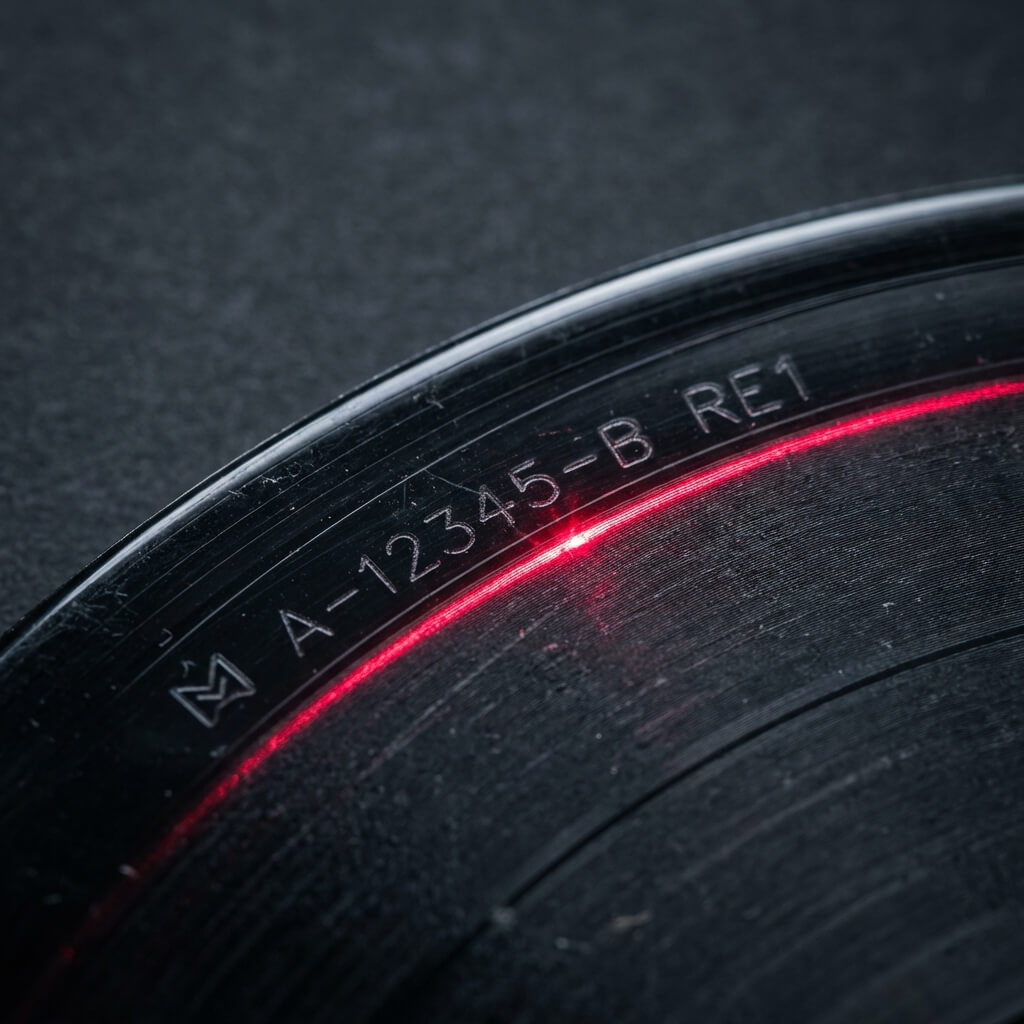
- Runouts on both sides: record the full inscription, including crossed-out text, mastering marks and stamped versus etched characters where visible.
- Mix and format: confirm mono or stereo, speed, number of discs and track sequence. A remix or alternate track cannot be judged as a mastering change alone.
- Credits and supplied extras: look for mastering information, inserts and any edition-specific packaging that matters to the comparison.
Runout inscriptions are not globally unique serial numbers. Several variants may share part of a matrix, while a database entry can list multiple runout variations. Match multiple details. Our matrix and dead-wax guide explains the identification workflow in more depth.
With Japanese imports, the disc, sleeve, obi and inserts also need to belong together. The Japanese pressing and obi guide covers that specific problem; an attractive obi alone does not prove first-press status.
A worked buying comparison
The following is a hypothetical example, not a price quote or a review of a named album. You find three copies of an album whose original stereo mix you want:
| Candidate | Evidence available | Remaining question | Sensible next step |
|---|---|---|---|
| Early domestic edition | Matching labels and runouts; attractive sleeve; seller says “visual VG+” | Is there audible groove wear? | Request playback of a quiet section and the last track on each side |
| Later repress | Same mix; clear photos; modest price; no mastering information | Is the cut the one you want, and does it play cleanly? | Compare complete inscriptions and condition notes |
| Current remastered reissue | Named engineer; edition-specific source notes; return policy | Do you like the tonal balance and presentation? | Seek comments about this exact edition or audition it |
For a listening copy, the later repress could be the best fit if it plays well and costs less. For a historical collection, the early edition could be worth waiting for in better condition. If buying remotely without a chance to audition, documented condition and an understandable return policy may matter more than a fashionable pressing description.
Notice that the decision does not require announcing a winner for all originals or all reissues. It requires identifying what is known, what is uncertain and which uncertainty you are willing to pay for.
How to compare two copies fairly at home
Keep the comparison narrow
Use the same turntable, cartridge, phono stage and speakers. Check setup before interpreting distortion as a pressing problem; the turntable calibration guide is a starting point. Follow the record cleaning and storage guide to clean both copies appropriately, and check the stylus according to the manufacturer’s instructions.
Compare the same mix and the same musical passage. Choose three short sections: a quiet opening for noise, a busy passage for clarity, and an inner track for tracking behavior. Play a full side afterward to decide whether small differences actually matter during normal listening.
Match loudness and write specific notes
A louder cut can seem more impressive even when it is not the one you ultimately prefer. Adjust the playback volume to make the passages reasonably comparable; do not assume the same volume-knob position creates equal loudness. If someone can switch copies without telling you which is playing, that can reduce expectation bias.
Write observations such as “vocal sibilance on the final track,” “bass masks the kick drum,” or “repeated tick before the chorus.” Separate recurring musical differences from isolated damage. “More analog” and “more expensive sounding” are difficult to act on and reveal little to a future buyer.
A streaming version can help confirm a song or arrangement, but it may use a different master. A phone recording of a record is also not a controlled comparison: the room, microphone and recording software add their own variables. Treat such clips as limited evidence, not a definitive sound-quality ranking.
Collector value is a separate decision
An original can command a premium because collectors want that edition’s historical context, artwork, scarcity or completeness. That premium is not a measure of sound quality. Reissues can also become collectible; neither category guarantees appreciation or easy resale.
Compare completed sales for the same edition and similar condition where reliable records exist. Asking prices tell you what sellers hope to receive. Include shipping, fees and the risk of paying for a condition grade that is not supported by playback evidence. Our record valuation guide expands that process without treating every old LP as an investment.
Set two limits if necessary: what you would pay for the music on a good playing copy, and the additional amount you personally accept for owning a particular edition. Making that premium explicit prevents a collector’s goal from masquerading as an audio requirement.
The five-question buying checklist
- Which exact edition is this? Verify country, format, labels and complete runouts rather than relying on the listing headline.
- What am I trying to buy? Choose between a dependable listening copy, a preferred mastering and a specific historical object.
- What does the evidence actually establish? Separate source disclosures, seller observations and unverified assumptions.
- What condition risks remain? Ask about playback, warps, centering and the return process, for new and used records alike.
- Is the premium justified for my goal? Compare equivalent editions and condition, then decide before bidding or buying.
When comparing several candidates, DiscSnap can help you start identifying and organizing records; the site links to its iOS and Android apps. Check the physical edition against the suggested result before treating it as confirmed. A cover scan cannot prove a mastering chain, authenticate a first pressing or reveal inaudible-to-the-camera groove wear.
You do not need the earliest or heaviest copy to enjoy an album. You need a copy whose documented edition, condition and cost match the reason you are buying it.
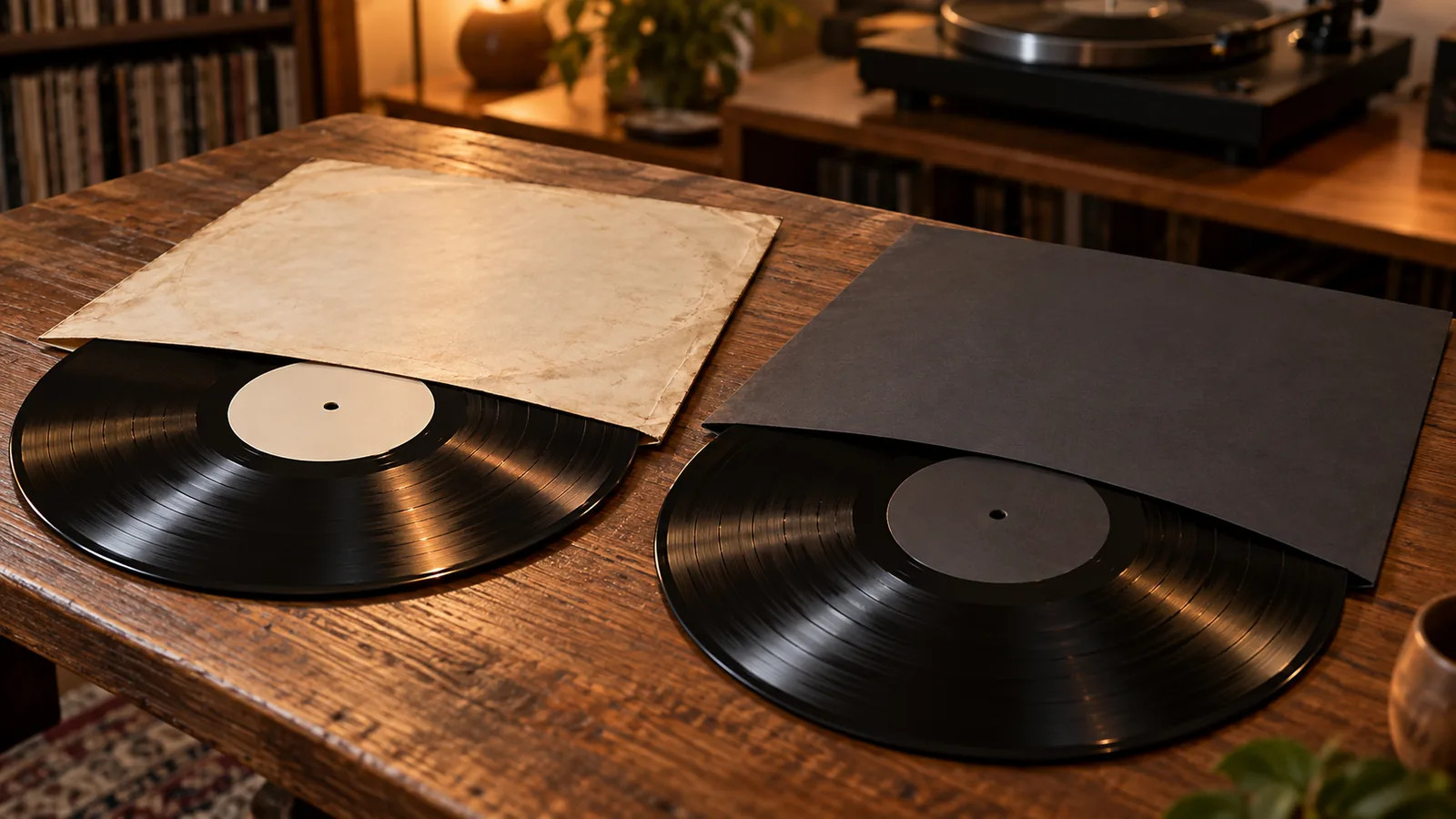
Editorial method: revised by the DiscSnap editorial team on 21 September 2026 using the primary sources linked above and an edition-first comparison method. The worked example is illustrative. This guide does not claim hands-on listening tests of the named reissue programs. Hero: original AI-generated editorial still life, not a photograph of authenticated editions.