

Whether you are hunting for rare gems at a weekend flea market, building an estate collection, or evaluating your personal vinyl archive, one fundamental truth governs the vinyl universe: condition is everything.
Two identical copies of a vintage pressing—for instance, a 1969 original of The Beatles’ Abbey Road or a 1973 first press of Pink Floyd’s The Dark Side of the Moon—can vary in market price by hundreds or even thousands of dollars based solely on their physical condition rating. A pristine copy might easily command $250, while a scratched, crackly copy of the exact same pressing might barely fetch $15.
To eliminate subjective guesswork between buyers, sellers, and archivists, the industry relies on the Goldmine Grading Standard. Established in the late 1970s by Goldmine Magazine, this universal rating system provides a standardized benchmark for evaluating both vinyl disc playback surfaces (media) and paper packaging (sleeves).
In this masterclass, we will demystify every level of the Goldmine grading scale, explain the critical differences between visual inspection and play-grading, and show you how to document record condition accurately in digital archives.
Quick Reference: The Goldmine Grading Chart
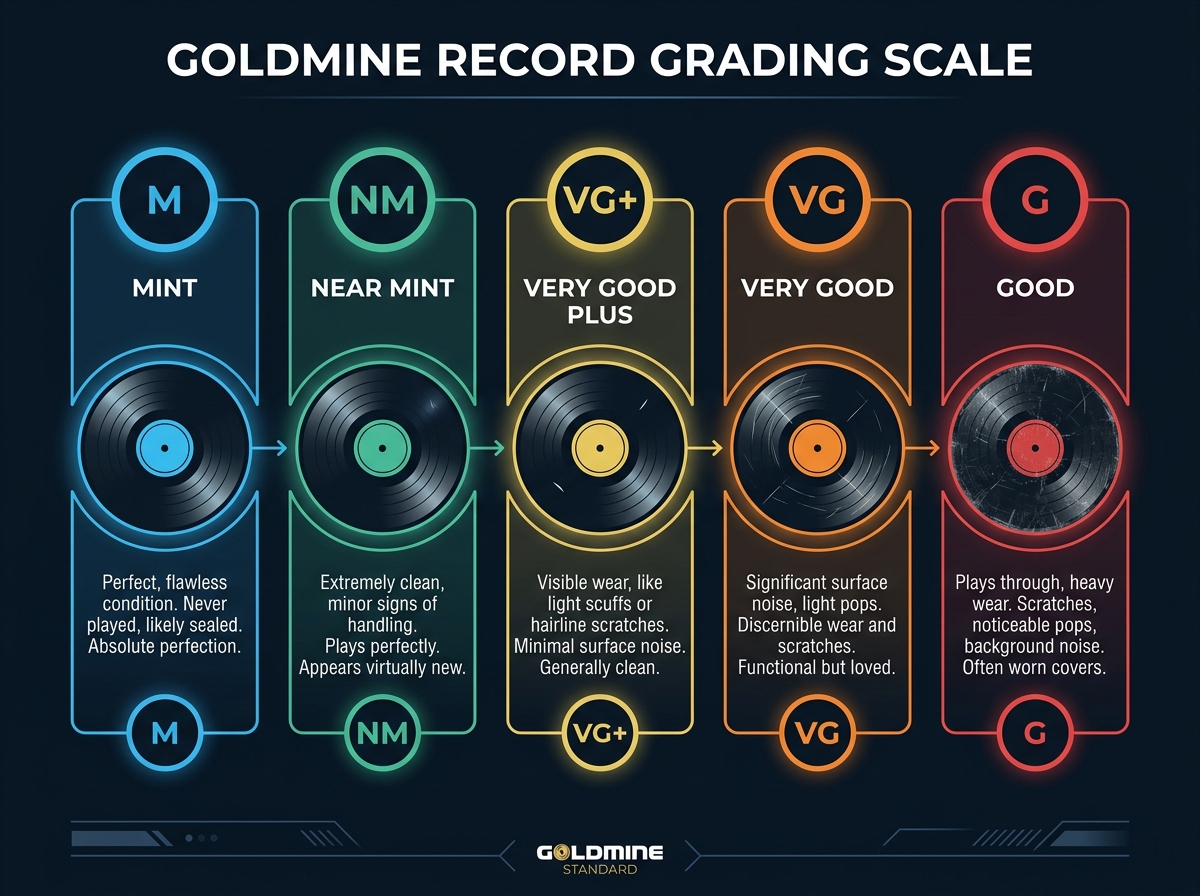
Before diving into detailed specifications, here is a breakdown of the standard condition grades used globally on marketplaces like Discogs, eBay, and private auctions:
| Grade | Code | Market Value Benchmark | Playback Quality | Visual Appearance |
|---|---|---|---|---|
| Mint | M | 100% (Top Market Price) | Perfect silence; no surface noise | Flawless; unplayed or factory sealed |
| Near Mint | NM / M- | 80% – 90% | Virtual audio perfection; negligible friction | Glossy surface; no visible scuffs |
| Very Good Plus | VG+ | 50% – 70% (Baseline Market standard) | Excellent dynamic playback; faint intro crackle | Minor hairline scuffs; minimal sleeve wear |
| Very Good | VG | 25% – 40% | Audible surface noise in quiet passages | Noticeable scuffs, light scratches, ring wear |
| Good / Good Plus | G / G+ | 10% – 20% | Continuous crackles/pops; no skips | Deep groove wear, split sleeve seams |
| Fair / Poor | F / P | 0% – 5% | Unlistenable; heavy skipping or stuck grooves | Warped, cracked, or severely damaged cover |
Detailed Breakdown of the Goldmine Condition Scale
1. Mint (M): The Elusive Gold Standard
What it means: A Mint record is physically perfect in every imaginable way. It has never been played, is completely free of manufacturing blemishes, and retains its factory-fresh mirror sheen.
- Vinyl Surface: Flawless. Zero hairline marks, paper scuffs, or fingerprints.
- Center Label: Clean, centered, with crisp printing and zero spindle marks around the center hole.
- Jacket & Sleeve: Unbent corners, vibrant ink, crisp edges, and no seam splits. Usually sealed in original shrink-wrap.
- Audio Experience: Complete silence between tracks. Pure analog dynamic range without surface hiss.
Collector Note: Serious archivists rarely assign a “Mint” grade to an unsealed record. Even removing a disc from its inner sleeve once can create microscopic paper sleeve friction marks. Treat “Mint” as a theoretical upper bound.
2. Near Mint (NM or M-): As Good As Used Vinyl Gets
What it means: Near Mint is the highest realistic grade for an opened, pre-owned record. The album shows zero signs of obvious handling wear, having been played only a handful of times on a calibrated turntable.
- Vinyl Surface: High gloss shine. Under direct halogen light, you might see tiny microscopic handling specks, but no visible scratches.
- Center Label: Free of writing, stickers, or heavy spindle trail marks.
- Jacket & Sleeve: Looks nearly new. No ring wear, cutout holes, or seam splits.
- Audio Experience: Crystal-clear reproduction. No pops, clicks, or persistent background hum.
3. Very Good Plus (VG+): The Collector’s Sweet Spot
What it means: VG+ is the bread-and-butter of vinyl collecting. A VG+ record has been handled with care and enjoyed responsibly by a dedicated collector. It exhibits slight signs of wear that do not ruin the overall listening experience.
- Vinyl Surface: May show light sleeve scuffs or superficial hairline scratches caused by paper inner sleeves. None of these visual marks can be felt with a fingernail.
- Center Label: May feature minor spindle trails or light fading around the hole.
- Jacket & Sleeve: Minor corner ding, subtle edge wear, or a small price sticker residual.
- Audio Experience: Dynamic and punchy. You might hear a soft surface crackle during silent lead-in grooves or quiet acoustic passages, but it never overpowers the music.
Organizing Tip: When managing your digital record collection, recording exact condition notes matters for resale and insurance. Using camera-assisted cataloging tools like DiscSnap allows you to log custom Goldmine grades and visual inspection tags for every album scanned into your cloud vault.
4. Very Good (VG): The Player’s Copy
What it means: A VG record exhibits obvious signs of frequent playback and handling. While still enjoyable for casual listening, the album shows clear visual and acoustic wear.
- Vinyl Surface: Surface sheen is reduced. Noticeable scuffs, light scratches, and mild groove wear are visible under standard lighting.
- Center Label: May have writing, tape residue, or spindle wear marks.
- Jacket & Sleeve: Ring wear (the circular imprint of the disc against the cover cardboard) is visible. Seam splits up to one inch may be present at the bottom or spine.
- Audio Experience: Surface noise (crackles and pops) is noticeable during quiet passages and song transitions, but the main music remains clear and enjoyable.
5. Good Plus (G+) and Good (G): Budget Placeholders
What it means: Despite the name, “Good” in record collector terminology actually indicates significant wear and tear. A G or G+ record has suffered from inadequate storage or heavy party playback.
- Vinyl Surface: Dull finish. Scratches are deep enough to feel slightly with a fingernail.
- Jacket & Sleeve: Severe seam splits, heavy ring wear, tape repairs, or writing across the artwork.
- Audio Experience: Continuous surface crackle, heavy pops, and distortion in high-frequency passages. The record will play through without skipping, but surface noise competes with the music.
6. Fair (F) and Poor (P): Decorative Artifacts Only
What it means: Damaged goods. These records have been severely warped, cracked, or scratched beyond functional play.
- Playback Status: Skips constantly, gets stuck in repeating loops, or damages the turntable stylus.
- Collector Value: Negligible (0% to 5% of catalog value). Useful only as wall art, framing pieces, or temporary placeholder fillers for extremely rare grails.
Visual Inspection vs. Play-Grading: The Dual Evaluation Rule
To grade vinyl accurately like a professional curator, you must combine two evaluation methods:
graph LR
    A[Record Inspection] --> B[Visual Grading]
    A --> C[Play Grading]
    B --> D[Bright LED / Halogen Light Check]
    B --> E[Sleeve & Label Wear Assessment]
    C --> F[Headphone Audio Auditioning]
    C --> G[Quiet Passage Noise Check]
D & E & F & G --> H[Final Goldmine Rating]- Visual Lighting Setup: Inspect vinyl disc surfaces under a strong, direct LED lamp or halogen spotlight at a 45-degree angle. Natural daylight often hides faint paper scuffs that become glaring under direct beam light.
- Fingernail Test: Gently glide the pad of your finger across suspect lines. If your fingernail catches in a groove line, the mark is a scratch (which produces loud pops) rather than a harmless sleeve scuff.
- Headphone Play-Grading: Audio play-grading using high-fidelity headphones is mandatory for high-value albums. Some visually scuffed records play surprisingly quiet, while glossy discs may suffer from hidden groove burn caused by worn phonograph needles.
Documenting & Appraising Condition in Digital Vaults
Accurate grading is not just an academic exercise—it directly governs your collection’s financial appraisal value. Market value benchmarks published on Discogs or eBay listings typically reflect median prices for VG+ condition copies.
Real-Time Valuation Shortcut: When flipping through crates at flea markets or estate sales, manually typing long album titles into web search engines takes minutes per LP. Using camera scanning tools like DiscSnap isolates record artwork and matrix codes in seconds, letting you cross-reference real-time market value averages adjusted for condition grades instantly.
Pro-Tips for Preserving High Goldmine Grades
- Replace Paper Inner Sleeves: Original paper inner sleeves degrade over time, creating paper dust that scratches record grooves. Upgrade to archival poly-lined anti-static inner sleeves.
- Store Vertically: Never stack vinyl records horizontally on top of each other. Heavy stacking causes warping and severe cover ring wear.
- Clean Before Grading: Dirt and dust can mimic surface crackle. Always wet-clean records with distilled water and dedicated vinyl cleaning fluid before making a final play-grading assessment.
By mastering the Goldmine Grading Standard, you protect your financial investments, build trust with fellow collectors, and ensure your vinyl collection remains in peak condition for generations to come.
For packaging specifically, use our vinyl sleeve condition guide to describe ring wear, seam splits, cutouts and missing inserts separately from the record itself.