

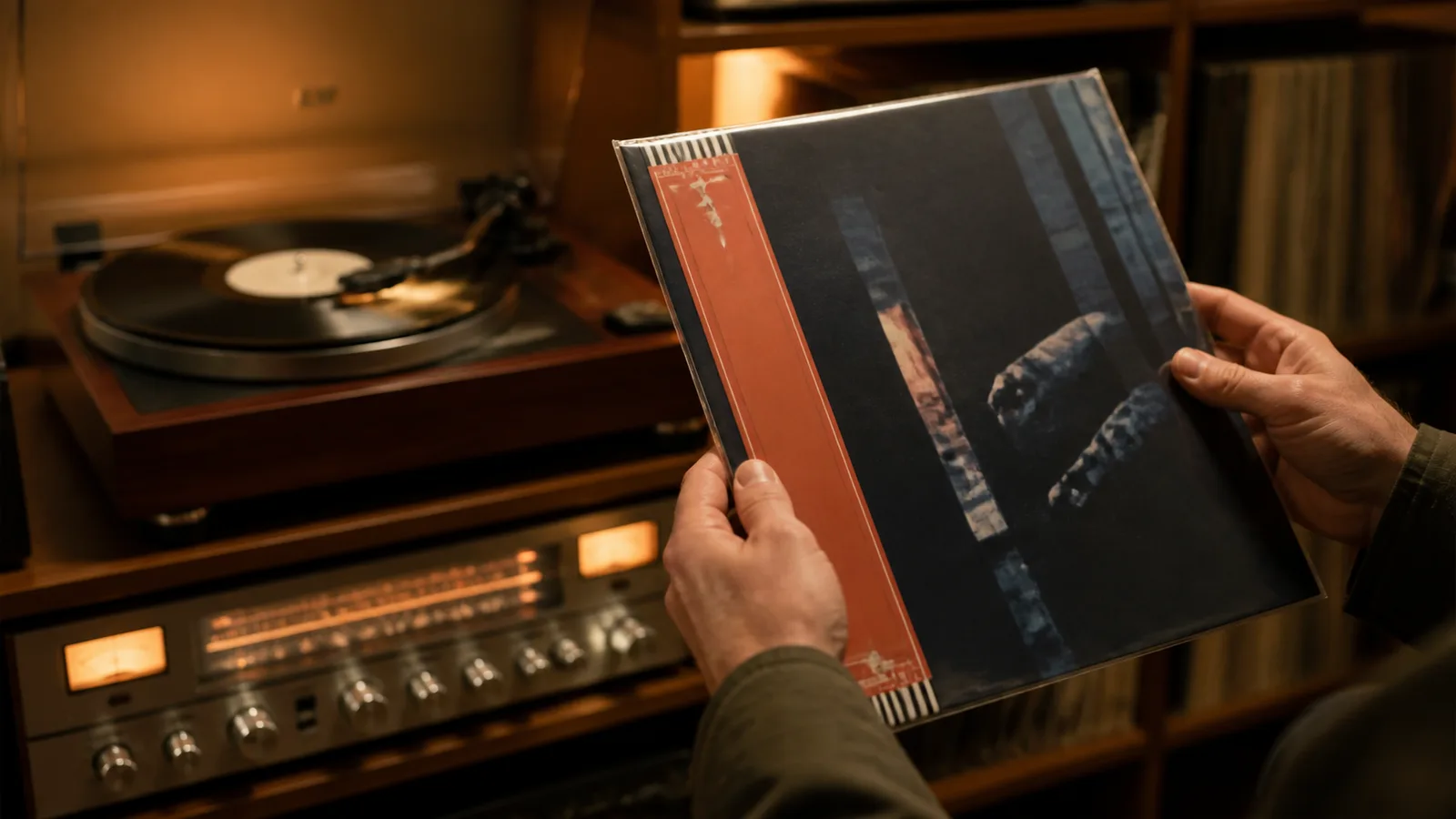
Japanese vinyl pressings have a reputation for careful manufacturing, quiet surfaces, detailed packaging, and mastering choices that can differ noticeably from US or European editions. They are also surrounded by collector myths. A Japanese copy is not automatically a first pressing, an obi is not proof of authenticity, and a higher asking price does not guarantee better sound.
The useful question is more specific: which Japanese pressing is this, is it complete, and does its condition justify the price? This guide gives you a repeatable way to answer it from the sleeve, obi, labels, inserts, catalog number, and dead wax.
What is an obi strip on a vinyl record?
An obi is a removable paper band wrapped around the outside of a Japanese record sleeve. Record companies used it to present information that was not convenient to print on imported or internationally designed artwork. Depending on the release, an obi may show:
- the artist and album title in Japanese;
- the domestic retail price;
- a Japanese catalog number;
- record-company branding;
- a series name or campaign;
- promotional copy, awards, or related titles;
- a barcode on later releases.
Collectors value an original obi because it is fragile and was often discarded after purchase. It is packaging, not part of the record itself, but a correct, clean obi can make a complete copy much harder to find. The increase in value varies enormously. It may be modest for a common 1980s title and substantial for a scarce 1960s or 1970s issue.
Do not confuse an obi with a lyric insert. The obi wraps around the jacket; the insert sits inside it. Many Japanese LPs originally included both.
Why Japanese pressings can sound different
Japanese plants became known for consistent quality control and low-noise vinyl compounds. That can produce a quieter background, but sound quality still depends on the source tape, mastering decisions, cutting level, and playback system.
Some editions emphasize clarity and high-frequency detail. Others sound leaner than an original UK or US cut. A later Japanese reissue may be beautifully pressed but made from a higher-generation tape. In other words, pressing quality and mastering quality are related but not identical.
Compare the exact release, not national stereotypes. Use listening notes from owners of the same catalog and matrix combination, and read our guide to original pressings versus reissues before paying an audiophile premium.
How to identify the exact Japanese pressing
1. Start with the catalog number
Japanese catalog numbers often combine a label or distributor prefix with digits, such as SOPL, 25AP, P-, EMS, or UIJY. The format changed between companies and eras, so the prefix can narrow the date and distributor.
Check the number in at least three places:
- the spine or back cover;
- the center labels;
- the obi or insert.
All three should normally correspond. A mismatch can mean a swapped record, a replacement obi, or a sleeve assembled from different copies. Some legitimate reissues reuse artwork, so a mismatch is a reason to investigate rather than an automatic verdict.
2. Read the price and tax notation
Printed prices help date an obi. Older issues may show a simple yen price; later ones can show tax-inclusive or tax-exclusive notation. A price that belongs to a later era may reveal that the obi comes from a reissue, even when the artwork resembles the original.
3. Inspect the record labels
Compare label color, logo placement, rim text, rights-society marks, and side indicators. Small typography changes can separate a first issue from a repress. Promotional copies may use white labels or carry Japanese sample markings such as 見本盤. A promo marking should also match the release history; a sticker alone is easy to imitate.
4. Verify the matrix and runout
The dead wax is usually stronger evidence than the jacket. Tilt the record under a soft directional light and copy every stamped or etched character from both sides. Note spacing, dashes, suffixes, and mastering marks.
Then compare those strings with reliable release databases and documented collector photos. Our matrix runout guide explains how to distinguish catalog references, lacquer numbers, and pressing-plant marks.
5. Inventory the inserts
Japanese releases often include lyric sheets, translations, posters, booklets, or company sleeves. Sellers sometimes describe an LP as “complete with obi” while omitting a rare insert. Look up the exact issue and make a checklist before buying.
When you are checking several similar variants, DiscSnap can capture the jacket and visible catalog information so you can compare candidates without repeatedly typing unfamiliar codes. Treat a scan as a fast starting point; confirm expensive copies against the physical matrix and included materials.
How to tell whether an obi belongs to the record
An authentic-looking strip can still be paired with the wrong issue. Use this checklist:
- Catalog number: it should match the jacket and labels.
- Label and distributor: the companies named on the obi should fit the record.
- Era: typography, paper, barcode use, and tax notation should make historical sense.
- Dimensions: the fold and width should fit the jacket naturally.
- Print quality: original offset printing usually has clean small type; obvious inkjet dots or muddy characters deserve scrutiny.
- Wear pattern: age and fading should be plausible beside the sleeve, though a well-preserved obi can legitimately look cleaner.
- Known variants: some albums had several legitimate obi designs across represses.
Avoid judging authenticity from paper color alone. Storage conditions can yellow, fade, or preserve two genuine examples very differently.
Common obi conditions and how they affect value
Grade the obi separately from the vinyl and cover. Useful notes include:
| Condition | What to record |
|---|---|
| Complete | No missing section; front and rear printing intact |
| Split | Clean separation at the top or bottom fold |
| Torn | Paper loss or a tear extending into printed areas |
| Faded | Sun bleaching, often strongest along the spine |
| Stained | Foxing, moisture marks, adhesive, or writing |
| Repaired | Tape or archival reinforcement; disclose clearly |
A neatly split obi can still display well and may be preferable to no obi. Tape, trimming, and recreated sections have a larger effect because they alter originality. Follow the same transparent approach used in the Goldmine grading system: describe what is physically present instead of relying only on a grade.
Counterfeit and reproduction warning signs
Reproduction obis can be useful for display when clearly disclosed, but they should never be priced as originals. Warning signs include modern glossy stock on a release known for uncoated paper, inaccurate folds, blurred microprint, colors that do not match documented examples, and a catalog number from another edition.
Also inspect the whole package. Pixelated cover art, incorrect label fonts, missing legal text, unusually shallow grooves, and undocumented runout strings can indicate an unofficial pressing. Use the full checklist in our guide to spotting fake vinyl and bootlegs.
A practical buying checklist
Before paying, ask the seller for clear photographs of:
- the full front and back cover;
- both sides of the obi;
- both center labels;
- every insert and inner sleeve;
- the runout on both sides under angled light;
- any split, tape, writing, foxing, or sun fade.
Search sold results for the exact catalog and matrix, not just the album title. Separate the value of rarity from condition and completeness. If sound is your priority, research that exact mastering. If collectability is your priority, confirm that the obi and inserts belong to the same issue.
The bottom line
The best Japanese vinyl purchase is not simply the cleanest obi or the highest-priced import. It is a correctly identified pressing whose record, sleeve, obi, labels, matrices, and inserts tell the same story. Work from the catalog number inward, verify the dead wax, and document each component. That process protects you from mismatched packages while making a genuinely complete copy easier to recognize—and easier to value accurately later.
Sources and editorial verification
Historical context was checked against Sony’s corporate history of CBS/Sony Records. Japan’s National Tax Agency tax history documents the introduction and later changes to consumption tax, which is why tax notation can support—though never prove—an obi date. For bibliographic research, the National Diet Library explains its Japanese bibliography and catalog services. Release-level identification should still be confirmed from the physical copy because sleeves, obis, and records can be mixed after sale.
Documenting a Japanese pressing in your catalog
Create one record for the complete object rather than cataloging the disc title alone. Photograph the front and back of the jacket, both labels, both sides of the obi, every insert, and each runout. Transcribe the catalog and matrix exactly, preserving punctuation and side suffixes. Record whether the obi is complete, split, repaired, faded, or reproduced, and keep seller claims separate from observations you verified yourself.
For valuation, save the date, currency, condition, and completeness of each comparable sale. A copy without an obi is not a reliable price comparison for a complete copy, and an asking price is not a completed sale. Recheck important valuations periodically because supply, demand, exchange rates, and artist interest change. This evidence-based record makes later insurance, resale, or collection review far more defensible than a single remembered price.
Before choosing an import for listening, compare original pressings and remastered reissues by mastering, condition and edition evidence.