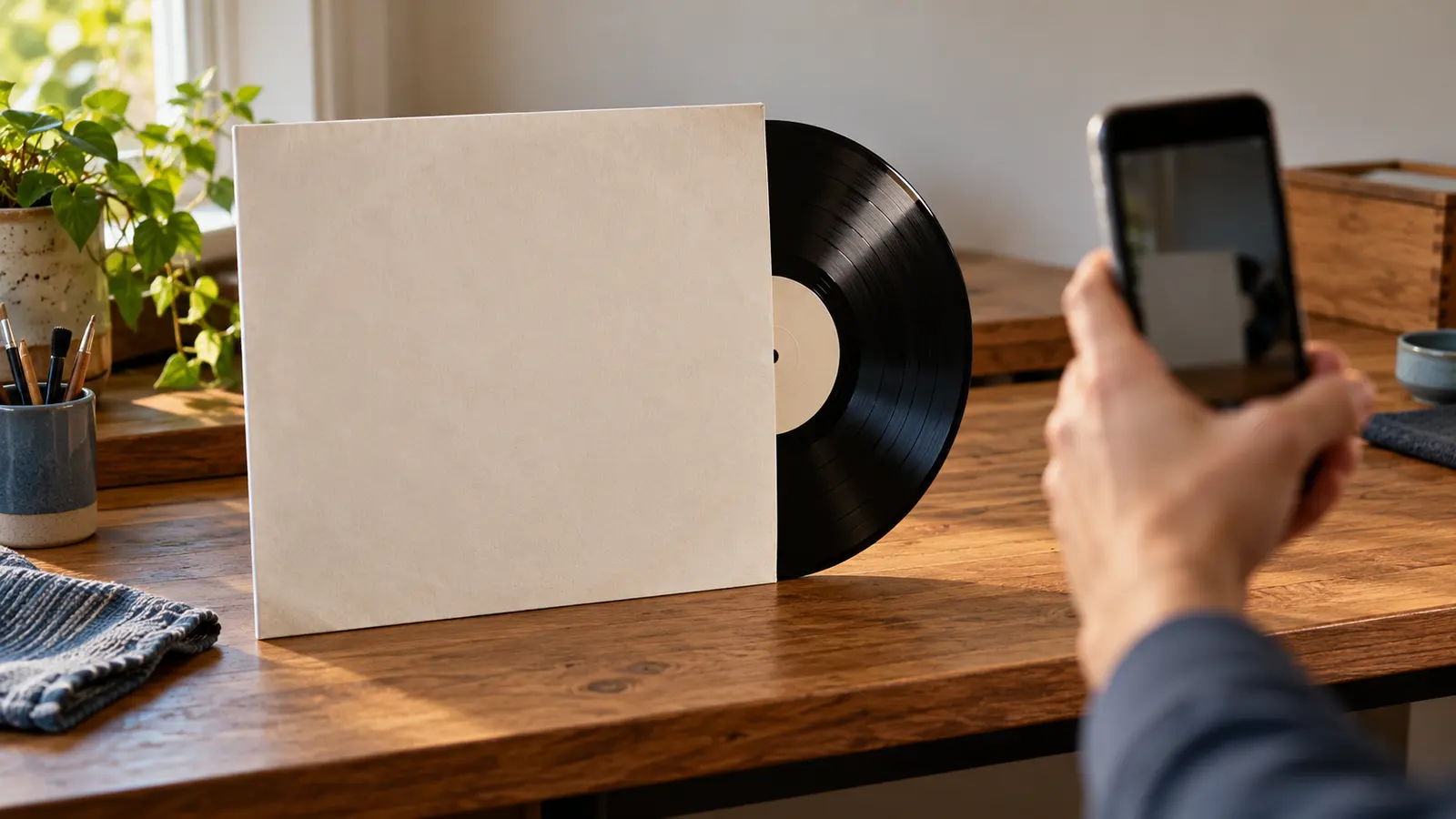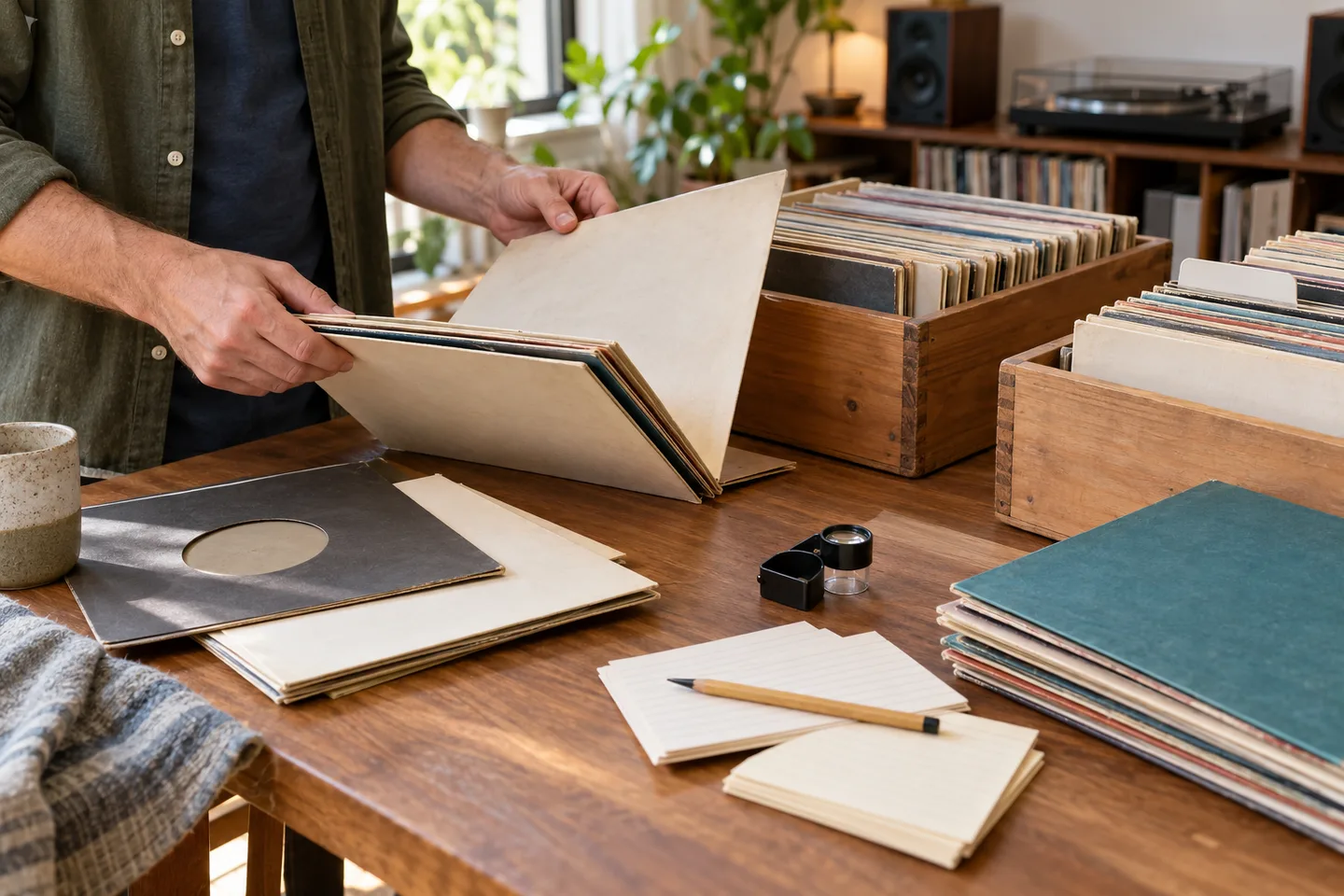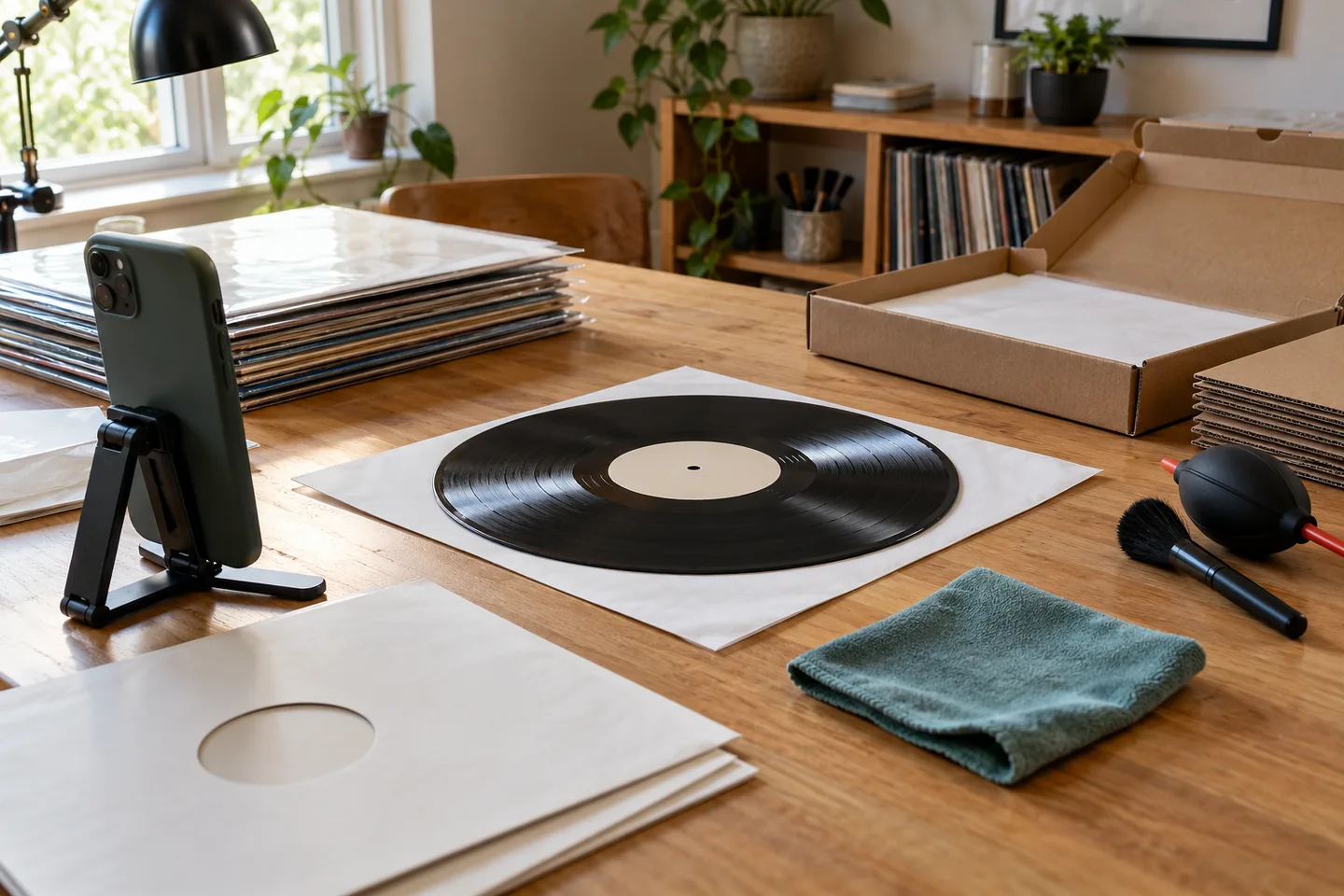
A good vinyl sale starts with an accurate description, not a hopeful price. Use DiscSnap as a documented identification and estimated-value starting point, then verify the physical copy, inspect its condition, take your own photographs and write down what is known. An estimate is evidence for a conversation; it is not a guaranteed selling price.
This guide covers preparation before you choose a marketplace or speak with a buyer. It does not teach checkout, shipping law, taxes, seller fees or a particular listing service. The aim is a clean record that another person can understand.
What should be verified before a record is offered?
Verify the exact release before you describe it as rare, original or valuable. Photograph the cover or label, compare DiscSnap’s suggested identity with the copy in your hand, and check the catalogue number, country, label layout, format, barcode and runout where those details separate releases. The pressing verification guide explains this evidence in depth; the label identification guide helps when the jacket is ambiguous.
The Apple listing documents cover or barcode identification, collection saving and low, typical and high market-value guidance. The Google Play listing documents cover or label scanning, estimated market value, collection saving and owned, wanted or for-sale categories. Store listings do not document identical controls, exact result fields or an iPhone/Android workflow parity. Treat the app result as a lead and record the platform and review date.
A verification checklist
- Artist, title and catalogue number agree with the physical copy.
- Country, label design and format are recorded when relevant.
- The sleeve and the disc are the same release, or the mismatch is disclosed.
- The suggested edition is compared with label, back cover and runout evidence.
- The estimate is dated and labelled as an estimate.
- Any uncertainty is written plainly instead of being filled with a guess.
How do you inspect the copy honestly?
Inspect the disc and sleeve separately. Under diffuse light, look for scratches, warping, residue and spindle wear. Play the record when you can; a visual grade cannot prove that a groove is quiet. Check the jacket for seam splits, writing, stickers, water marks and corner wear. Keep the vocabulary consistent with a recognised grading reference such as Discogs’ grading guidance, and say which scale you used.
Do not call a copy “Near Mint” because the artwork is clean. Do not infer playback quality from a photograph. If the record has not been played, write “visual inspection only.” If only one side was tested, name that side. A short, specific note is more useful than a flattering adjective.
How should photographs support a sale record?
Take photographs of the actual copy on a neutral surface. Include the front and back of the jacket, spine, labels, inner sleeve, inserts and any defect that a buyer would want to see. Use soft side light to control glare, keep the catalogue number legible and avoid filters that hide wear. A close-up supplements a full view; it does not replace it.
Keep the image set with a simple copy identifier and capture date. Never use a stock image of a clean jacket for a worn copy. If a sticker or replacement sleeve affects the description, show it. Honest images reduce avoidable disagreement after a sale.
How do you separate an estimate from an asking price?
DiscSnap’s value guidance can help you frame a research question. It does not know every defect, local buyer, shipping cost or final negotiation. Record the estimate range, currency and date, then decide your asking price separately. Compare the exact edition and condition with recent, relevant examples when you have reliable evidence; do not use a headline price for a different pressing.
| Field | Example of a careful entry |
|---|---|
| Identification | Artist, title, catalogue number and country, with evidence note |
| Condition | Media: VG+ visual; sleeve: VG; one side play-tested |
| App estimate | Low/typical/high shown on 29 October 2026; estimate only |
| Asking price | Your proposed amount, with the reason and date |
| Exceptions | Sticker residue, seam split, missing insert or uncertain runout |
The values in this table are a hypothetical documentation example, not a price recommendation. The valuation guide covers edition, condition and market evidence without turning an estimate into an appraisal.
Can DiscSnap create a marketplace listing?
The public store descriptions support identification, collection management and, on Android, an intent to sell. They do not establish an in-app marketplace, checkout, listing syndication, buyer messaging or shipping workflow. Use the app’s documented collection features where available, but keep the full copy record in a spreadsheet or note until the current platform workflow is verified. Do not claim that marking an item for sale transfers ownership or publishes an offer.
Before a record leaves your collection, update your own inventory with the date, buyer reference and what was actually transferred. Keep a copy of the photographs and description according to your normal record-keeping practice. The catalog guide can help structure the inventory; it does not provide transaction services.
A repeatable preparation sequence
- Photograph the cover or label and review the suggested identity.
- Compare the candidate with the physical catalogue number, label and runout.
- Inspect media and sleeve separately; play-test when practical.
- Photograph the actual copy, including defects and included extras.
- Record the dated estimate and keep it separate from your asking price.
- Write a concise description that distinguishes observation from inference.
- Choose a sales destination whose current terms, fees and delivery rules you have read.
- Update your personal collection record when the copy is transferred.
The sequence deliberately pauses before publication. If a pressing detail remains uncertain, say so and ask for evidence rather than presenting the strongest possible claim.
What does a truthful description sound like?
“1978 UK pressing, catalogue number XXXX, identified from the label and runout; media visually VG+ and side A play-tested; sleeve VG with a 2 cm top-seam split; one insert present; DiscSnap estimate reviewed 29 October 2026 and treated as guidance only.” This is a model of structure, not a description of a real release. It tells a buyer what was checked and what remains limited.
DiscSnap can shorten the first identification step, but the seller remains responsible for matching the physical copy to the description. Keep the app’s estimate, your observations and your proposed asking price as three separate facts. That separation makes the record easier to revise when a better source or a closer inspection changes your understanding.
Editorial method and follow-through
This guide uses DiscSnap’s public Apple listing, Google Play listing, and Discogs grading guidance, reviewed 29 October 2026. Those sources document product scope and grading vocabulary; they do not establish accuracy, guaranteed prices, platform parity, or a marketplace. The conceptual hero is AI-generated and contains no real listing or app interface.
Create a sale-preparation record only after identity and condition are documented. Give the copy an inventory ID, keep photographs of the actual sleeve, labels, inserts and defects, and distinguish observation from interpretation. A useful worksheet has columns for copy ID, candidate release, confirmed identifiers, media and sleeve condition, completeness, photographs, estimate source, proposed asking price, destination, date and review status. Recheck the description against the physical copy immediately before publishing. When the record transfers, preserve the historical row and date the status change rather than overwriting the earlier evidence.
A fictional complete-copy dossier
Imagine a copy labeled SALE-014, a 1978 album in a plain sleeve. The front cover is clean, the top seam has a 3 cm split, the record has light hairlines, and the inner sleeve is a later replacement. The label shows catalogue number ABC 123; the runout reads ABC 123 A-2 on side one and B-2 on side two. The DiscSnap suggestion names the album and a likely release, but the country remains unresolved. The dossier therefore says: “candidate release, catalogue number confirmed, country unconfirmed; media and sleeve observations recorded; estimate kept separate.” It does not call the copy a first pressing.
Attach the actual photographs, the source links used for comparison, and the date of each review. If a buyer asks about a discrepancy, you can show exactly which identifier supports the description and which question remains open. That is more persuasive than a confident adjective.
How should discrepancies be resolved?
Pause publication when the proposed title, label, format or catalogue number differs from the inventory row. Compare the physical label first, then the sleeve and matrix. If the label belongs to one release and the sleeve to another, describe the mismatch and photograph both; do not silently merge them. If a database entry has an image that conflicts with the copy, retain the competing entry in your note and explain why you selected one. Ask a specialist or shop for a second view when the distinction affects the description materially.
After a sale, record the date, destination and final status in a private transaction log, while preserving the original listing dossier. A returned or cancelled transaction becomes a new event rather than an overwritten history. This keeps future inventory work accurate without exposing private contact or payment details.
Keep a distinction between an estimate, an asking price and a completed transaction. An estimate can be stale or based on a different edition; an asking price expresses your decision; a completed transaction is evidence about one buyer and one copy. Record all three labels explicitly and include the date. If you cannot explain the difference in one sentence, leave the field blank until the identity review is complete.