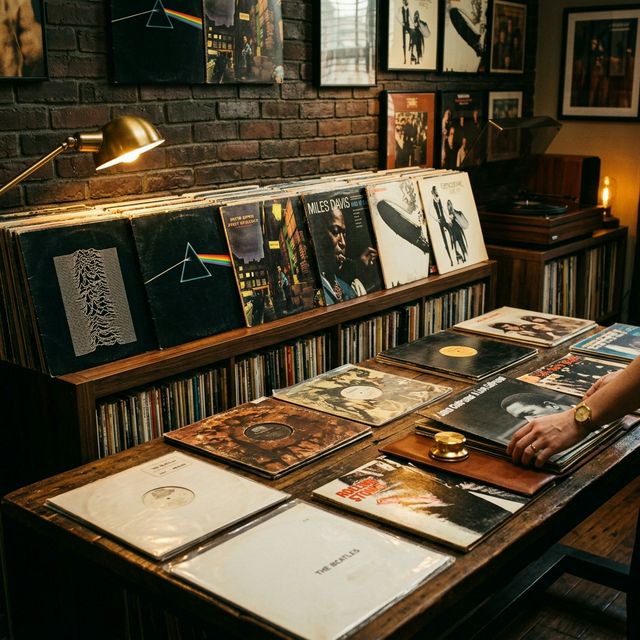

A well-documented benchmark for expensive pressed vinyl is Ringo Starr’s personal copy of the Beatles’ White Album, numbered 0000001, which sold for US$790,000 on 5 December 2015. That result concerns one artist-owned copy. It does not establish a price for another copy of the album, even one with an early sleeve number. Julien’s auction summary identifies the copy and result; Guinness’s record entry supplies the sale date.
The most valuable vinyl records are difficult to compare because popular lists mix pressed LPs, unique recording acetates, asking prices and confidential transactions. This guide uses a small set of documented historical sales to explain those differences. It is a curated comparison, rather than an exhaustive current ranking or an appraisal of your records.
Documented expensive vinyl: two instructive sales
These examples are commercially pressed vinyl with unusually significant ownership or packaging. Prices remain in the currency reported by the auctioneer. Neither figure is adjusted for inflation, converted at a current exchange rate or presented as a present-day valuation.
| Specific copy | Sale date | Reported result | What the comparison requires |
|---|---|---|---|
| Ringo Starr’s Beatles White Album, No. 0000001 | 5 December 2015 | US$790,000 | The artist’s ownership history and this numbered copy |
| Beatles Yesterday and Today, sealed stereo first-state butcher cover, Capitol ST2553 | 12 March 2022 | US$112,500 | Matching stereo edition, cover state, seal and documented condition |
The cited summaries do not separately establish hammer price, buyer’s fees and seller’s proceeds for these two results. We therefore call them reported results. Before using any auction result as a comparable, obtain the lot’s sale terms and determine precisely what its published number includes.
Ringo Starr’s White Album: provenance changes the object being bought
The title, music and physical format alone cannot explain this sale. A buyer was acquiring a particular copy associated with a member of the Beatles, with an exceptionally early sleeve number. Replacing that copy with an ordinary retail example would remove a central part of what was offered.
This distinction matters when a collection contains a numbered white sleeve. A low number is a detail worth recording, but it is not proof of artist ownership. A statement from a previous seller is also weaker than an independently documented ownership chain. Keep the sleeve number, disc identifiers and provenance documents separate in your notes so that one detail does not silently stand in for another.
For your own copy, identify both records, their labels and their runout inscriptions, then inspect the sleeve and inserts. The guide to matrix and runout numbers explains why markings on the disc can be more useful than the artwork. A famous cover is a starting point for research, not confirmation that a copy matches a famous sale.
Yesterday and Today: cover state, stereo and condition all matter
Heritage’s lot 89051 in auction 7233 records a US$112,500 result on 12 March 2022 for a sealed stereo first-state copy, Capitol ST2553. Those qualifiers belong beside the price. Removing them turns a specific result into a misleading price tag for an album title.
The cover’s state describes its history: first-state copies retain the original butcher artwork without the replacement artwork pasted over it; second-state copies have the replacement cover pasted over the original; third-state copies have had that overlay removed. A peeled cover does not become an untouched first-state cover because the underlying picture is visible again.
Do not peel a cover to investigate it. An alteration can destroy evidence and damage the object. If a potentially significant cover is difficult to identify, seek an experienced specialist’s assessment before attempting treatment.
Heritage’s description also discloses wrap tears and age stains. “Sealed” therefore does not mean “free of defects,” and the auctioneer’s grades are its assessments, not a physical inspection by DiscSnap. When comparing another copy, ask whether the seal, stereo format, cover state and disclosed flaws actually match. Our Goldmine grading guide provides a framework for describing record and sleeve condition separately.
Why unique acetates belong in a separate comparison
An acetate is not interchangeable with a mass-produced vinyl LP. The following objects concern unique recordings or exceptional recording history. Their sale prices can help explain the market for musical artifacts, but they are poor comparables for ordinary pressed records.
| Audio artifact | Historical sale | Reported result | Necessary qualification |
|---|---|---|---|
| Elvis Presley’s first-recording My Happiness acetate | January 2015 | US$300,000 | Graceland states that realized prices include a 25% buyer’s premium |
| Bob Dylan’s 2021 recording of Blowin’ in the Wind, one-of-one Ionic Original acetate | 7 July 2022 | £1,482,000 | A unique recording object; physical ownership does not convey copying or distribution rights |
Elvis Presley: a first-recording artifact
Graceland’s auction-results announcement reports US$300,000 for the My Happiness acetate in January 2015. The announcement explicitly says its realized prices include a 25% buyer’s premium. That published total is neither the hammer bid alone nor the seller’s net receipt.
The useful lesson is about the identity of the object. A commercially issued record containing the same song does not acquire the history of the first-recording acetate. Nor does an unfamiliar blank label establish that a disc is an early recording artifact. Identification needs evidence that connects the physical object to the recording and its history.
If you encounter a possible lacquer or acetate disc, do not assume that advice for cleaning a modern vinyl LP applies. Preserve the object and seek material-specific handling guidance. Researching a recording’s historical importance should not require experimenting on the disc itself.
Bob Dylan: a new recording, not the original 1960s album
Christie’s sale announcement reports £1,482,000 on 7 July 2022 for a unique Ionic Original acetate of Dylan’s 2021 recording of Blowin’ in the Wind. This is not a price for a 1960s retail LP containing the song.
The lot description describes the disc’s construction and expressly excludes intellectual property rights, including copying and distribution rights, from the sale. A buyer can own a physical recording object without acquiring the right to reproduce its music. That legal distinction can change what is being offered and should be read before comparing apparently similar sales.
We retain the sterling result rather than choosing a convenient modern dollar conversion. Exchange-rate changes and differences in fee reporting can create a false ranking even before differences between the objects are considered.
Why some famous headline prices are omitted
The US Department of Justice confirmed a sale of Wu-Tang Clan’s unique album on 27 July 2021, but its announcement says the buyer and price were confidential. That source cannot verify a precise public sale price or a calculated seller’s net. We do not insert either into a vinyl auction table.
An insured value, presale estimate or seller’s asking price may be useful context, but none demonstrates a completed transaction. Keep those categories visibly distinct when checking any “most expensive records” list.
What an exceptional sale can and cannot tell you
Scarcity, demand, condition and provenance can all matter. There is no fixed formula that assigns a guaranteed minimum price to a record because only a few copies survive. A rare object with limited demand can attract little competition; a more widely available edition can have an active market.
Exceptional auction lots also form a selected sample. Auctioneers choose noteworthy objects, and publicity tends to highlight strong sales. Unsold lots, withdrawn lots and ordinary transactions are less visible. You cannot calculate a dependable annual return for vinyl from a handful of celebrated results.
Separate three questions:
- Which edition is this? Check country, format, label, catalogue number and runouts. Read original pressings versus remastered reissues when a first issue and later edition share artwork.
- What condition is this particular copy in? Record disc and sleeve defects separately. A description should explain damage, missing parts and any limits on inspection.
- What extra history belongs to this copy? Artist ownership, signatures and unusual associations need supporting evidence. They are not properties shared by every copy of the edition.
For ordinary collectible albums, our classic-rock edition case studies provide a more practical route into comparisons. They focus on identifiable editions rather than replacing everyday market research with celebrity-owned examples.
Read an auction price before using it
Identify the kind of number
A hammer price is the successful bid when bidding ends. A buyer’s premium is an additional charge under the auctioneer’s terms. Tax, shipping and other costs may apply separately. A published “price realized” needs its own definition; do not assume every auction house presents totals identically.
A seller’s proceeds can differ again because seller-side fees and other agreed charges may be deducted. Unless the source supplies those terms, do not subtract an invented percentage and label the answer a verified net sale.
Hypothetical arithmetic: a bid of £1,000 with a stated 20% buyer’s premium produces £1,200 before any applicable tax or shipping. This illustration is not a statement of any auctioneer’s actual fee schedule. Comparing the £1,000 bid with another lot’s £1,200 premium-inclusive result would exaggerate their difference.
Build a defensible comparable set
Start with completed sales of the same edition, then narrow by condition and completeness. Keep a short research table containing the sale date, edition evidence, grade, included packaging, price basis and source link. Mark an unknown field as unknown rather than quietly filling it from another listing.
Reject a comparison when its main price driver is absent from your copy: documented artist ownership, an untouched recalled cover or a unique recording cannot be supplied by a matching album title. A sale in another currency or a much older period may still be informative, but show that limitation alongside the result.
When only one remotely similar transaction exists, report a thin evidence base. Several independent comparable sales are more informative than one spectacular outlier. The record-value research guide explains how to turn identification and condition notes into a cautious assessment.
Check your collection without losing useful evidence
Begin with an orderly record of what you have. Capture the album title, label text, catalogue number, country clues, both sides’ runouts and the contents of the sleeve. Note what you could not read or inspect. Photograph distinctive packaging and retain any existing ownership documentation.
Use DiscSnap to help identify and organize records as a starting point, then confirm the edition manually. A cover scan cannot establish a concealed runout, an original factory seal, a signature’s authenticity or an artist’s ownership history. The app should help you decide what to research next; it does not replace those checks.
If evidence points to an exceptional object, ask a suitable dealer or auction specialist what they would need to assess it. Send clear photographs and precise notes, explain which details remain uncertain, and ask about assessment and selling fees before making commitments. Avoid repairs, peeling or speculative cleaning while identity is unresolved.
For an ordinary collection, beginner collecting guidance can help prioritize the process. A useful inventory includes enjoyable, modestly priced records as well as possible rarities. There is no need to turn every unfamiliar pressing into an investment hypothesis.
DiscSnap is available on the App Store and Google Play. Use identification and organization to build better research notes, then verify condition, edition and sale evidence before relying on a value estimate.
Questions collectors ask
What is the most expensive vinyl record ever sold?
Ringo Starr’s numbered White Album copy is a documented pressed-vinyl benchmark at US$790,000 in December 2015. This guide does not claim an independently exhaustive current record: new transactions and private sales may not be publicly documented. Unique acetates need a separate comparison.
Are common album titles valuable?
A familiar title can exist in many editions and conditions. Research the actual pressing and its packaging before choosing comparable sales. A headline price for an artist-owned copy does not establish the value of another copy with the same music.
Does heavier vinyl or a low sleeve number prove rarity?
Neither detail proves the whole case. Weight describes a physical feature; a sleeve number is one identifier. Both need to be considered alongside edition evidence, completeness, condition and any documented history.
Will valuable records keep increasing in price?
A historical auction result does not promise a future sale or return. Demand can change, condition can deteriorate, and fees reduce proceeds. This guide supplies evidence-reading methods, not an investment forecast.
How do I avoid an expensive identification mistake?
Confirm the edition from more than one physical detail, record uncertainties and scrutinize ownership claims. If authenticity is in question, consult the guide to counterfeit and bootleg records before treating a bargain as a verified rarity.
Editorial method and sources
Prepared by the DiscSnap Team; reviewed 11 October 2026. We checked the auctioneer, auction organizer and government pages linked beside the claims. This article distinguishes reported sale results, fee disclosures and unanswered questions. We did not physically inspect these lots, independently authenticate them or conduct an exhaustive census of private sales. Prices describe the cited historical transactions, not current appraisals.