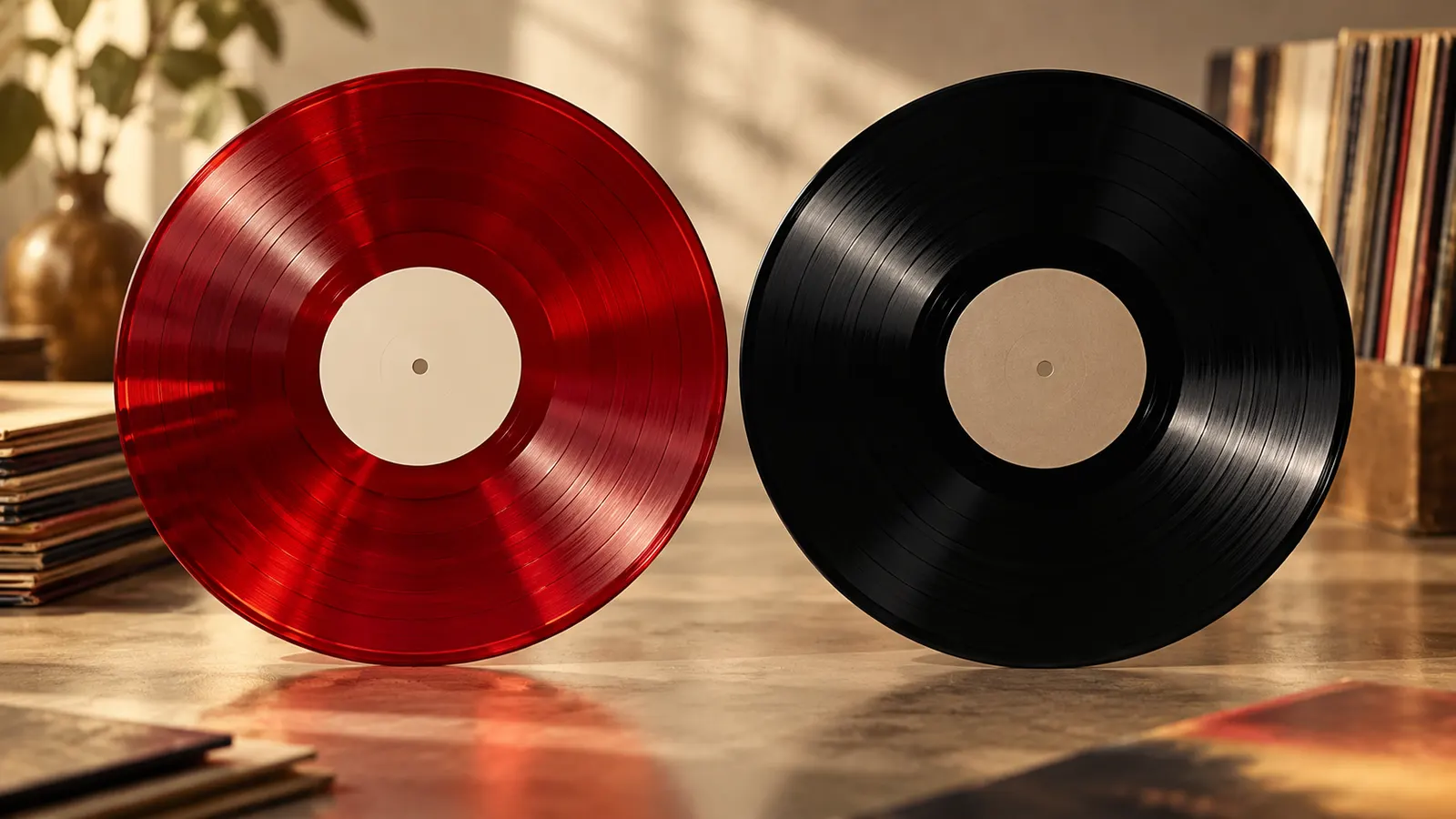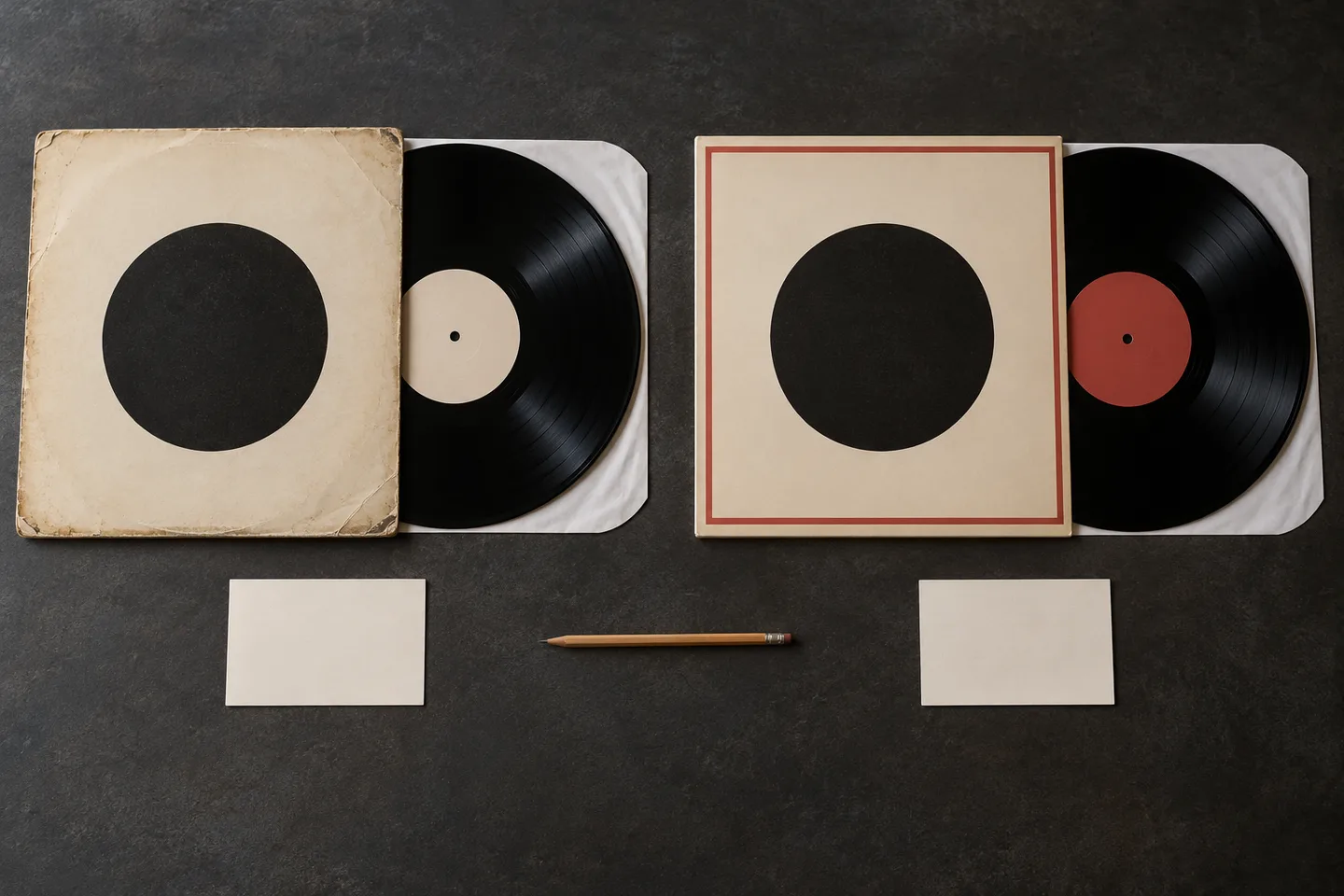
Two records with the same title are not automatically duplicates. They may be two copies of one release, two editions from different countries, or one record paired with the wrong sleeve. Use DiscSnap to create a candidate identity from a cover or label photograph, then compare both physical objects before you merge, keep, sell or delete anything. The app can support identification and collection decisions; it does not establish that two copies are identical, and the public product descriptions do not document automatic duplicate detection or merge controls.
Start with three separate ideas
An album is the musical work. A release is a documented edition with a label, country, date, format and catalogue details. A copy is the object in front of you, with its own condition, inserts, stickers, signatures and sleeve history. Two copies can point to the same release while one has a torn jacket. Two releases can share an album title while differing in mastering, country or catalogue number. Your inventory becomes unreliable when these levels are collapsed into one “duplicate” label.
Before opening a database, give each physical object a temporary identifier such as SHELF-014-A and SHELF-014-B. Photograph the front and back of each sleeve, then place each disc on a clean inner sleeve while you inspect it. Keep the photographs and notes together. The identifiers belong to your external working record; do not assume the app provides a quantity, copy, location or lending field unless the current interface explicitly shows it.
Use DiscSnap for the candidate, not the verdict
Photograph the cover or label that is easiest to read. A clear cover may identify the album; a label can expose a catalogue number or country that separates editions. DiscSnap’s public store descriptions support cover and label identification and saving identified records. They do not document automatic duplicate matching, a confidence score, simultaneous recognition of a batch, or a guaranteed release-level result. Read the suggested artist, title and release clues, then check the object in your hand.
Use the App Store listing for the current iPhone description and the Google Play listing for Android. The listings are product-scope evidence, not a promise that every control is shared across platforms. The language in this guide describes a collector’s decision; it does not rename buttons or invent fields.
Compare the two copies side by side
Put both sleeves on the same table and make an observation list before researching. Compare the title and artist, but then move to details that can actually separate releases: label logo and address, catalogue number, country wording, format, speed, barcode, copyright line, spine text, inner sleeve and inserts. Inspect both label sides. Read the runout manually when it matters, using angled light and a photograph rather than guessing a blurred character.
Condition and acquisition are copy facts. Record seam splits, ringwear, writing, stickers, warps, surface marks and missing inserts separately for A and B. Note when you bought each copy, from whom, and at what price if that information is useful to your own records. Do not use a condition difference to create a new release entry, and do not use a matching cover to erase a real difference in the discs.
A hypothetical comparison table
The values below are invented teaching examples. They do not reproduce a DiscSnap screen or identify a real release.
| Evidence | Copy A | Copy B | Interpretation |
|---|---|---|---|
| DiscSnap candidate | Artist/title, ABC 123 | Artist/title, ABC 123 | Same album and release family are plausible |
| Label catalogue number | ABC 123 | ABC 123 | Supports one release, not proof by itself |
| Country line | Made in UK | Made in UK | Supports the same territory |
| Label address | London address | London address | Consistent with the candidate |
| Side A runout | ABC-123-A2 | ABC-123-A2 | Consistent; inspect both sides before merging |
| Sleeve | Small sticker, intact seam | Replaced sleeve, different rear text | Copies have different histories; do not discard this note |
| Media condition | VG+ | VG | Keep condition and acquisition separate |
| Decision | Retain | Sell or retain as second copy | Same release, two physical copies |
Now change one row: Copy B has a different country, catalogue suffix and label address. The title and artwork still match, but the evidence points to a different release. Search the relevant catalogue entry and compare its complete details. A barcode or runout difference is not automatically a new release; database guidance allows some minor identifier variations as variants. Conversely, a collection of differences should not be flattened into one record simply because the cover looks familiar.
Reconcile physical count with collection entries
Count objects before editing your digital inventory. If you have three discs and two sleeves, write that down. A missing sleeve may mean one copy was stored elsewhere; a replacement sleeve may explain why a photograph does not match the disc. For box sets and multi-disc albums, count the set and its discs deliberately so a single release is not mistaken for several albums.
Make an external reconciliation sheet with columns for temporary copy ID, artist, title, candidate release, physical format, catalogue number, country, condition, sleeve status, acquisition note, current location and decision. This sheet is intentionally external: the documented product descriptions do not establish custom copy quantities, location fields, attachments, automatic merge, or delete-recovery workflows. If the app only lets you save an identified item, keep the copy-level detail in your own non-sensitive notes.
When the same release appears twice, decide whether you want two physical copies. A spare can be useful if one copy is worn, incomplete or reserved for a different listening space. A duplicate can also be a candidate for sale, trade or donation. Do not remove an entry merely because the title appears twice; first confirm whether the entries represent two objects or two editions.
Decide what to retain
Retain both copies when they are distinct editions, when each has a meaningful provenance, or when you have a practical listening reason. Retain the better copy when the releases are identical and the second adds no value to your collection goals. Keep the copy with the complete insert or original sleeve if completeness matters to you, but record the reason rather than treating it as an objective rule.
Condition is not the only decision factor. A noisier copy with an original sleeve may be more useful to a collector than a cleaner disc in a replacement jacket. A signed copy, a local pressing or a documented gift can justify retaining an otherwise ordinary duplicate. Write the reason in plain language: “Keep B for complete insert; sell A because sleeve is a replacement.” This helps you revisit the choice without reconstructing the whole comparison.
If you plan to sell one, identify it separately, photograph its exact condition and keep its candidate release linked to its own copy ID. An estimate is not an asking price. Consult the vinyl value guide and Goldmine grading guide for broader context, then describe what the buyer will actually receive. If the collection is insured, the insurance inventory guide explains why copy-level photos and dated notes matter.
Review before deleting or merging
Deletion is a separate decision from duplicate classification. Before removing an entry, compare the physical count with the remaining records, export or preserve any notes you need, and confirm that you are not deleting the only reference to a different country or format. If the app presents a control you have not documented, read its current behavior on a disposable sample first; do not infer that a delete action merges copies or preserves history.
Use a short review checklist:
- Are the two temporary copy IDs still present in your external sheet?
- Did both labels, sleeves and runouts receive separate observations?
- Is the candidate release supported by the physical evidence?
- Are condition, acquisition and location notes attached to the copy rather than the release?
- If one copy is sold, is the ownership change recorded with its date?
- Have you preserved the photographs and the reason for the decision?
If any answer is no, leave the entry provisional. An unresolved duplicate is safer than a permanently deleted record whose evidence cannot be recovered.
Three common traps
The first trap is the “same artwork” assumption. Reissues often reuse a famous image while changing the label, catalogue number or mastering. The second is the “same catalogue number” assumption. A number can identify a family of releases while country, format or suffix separates entries. The third is the “same condition” assumption. Even when both discs are the same release, a replacement sleeve, different inserts or a signed jacket make the copies materially different to a collector.
When a seller or database shows only one photograph, do not fill in the missing details from memory. Ask which object the image represents and compare it with your own copy. If you cannot ask, record the limitation in your notes and avoid calling the match complete. A transparent unknown keeps the next decision open; a guessed duplicate can cause you to sell the wrong copy or lose a useful provenance trail.
Helpful links for the next check
The vinyl cataloging guide covers a broader inventory structure. Use the pressing verification guide when the two records may be different editions, and the originals versus reissues guide when age or mastering is part of the question. These guides add evidence checks without claiming that DiscSnap can authenticate or merge records automatically.
Editorial method and limits
This guide was reviewed on 28 October 2026 against the current DiscSnap Apple App Store and Google Play descriptions, Discogs identification guidance and the active weekly editorial plan. The comparison table is hypothetical. No automatic duplicate detection, bulk recognition, quantity field, copy-level location, merge, delete-recovery, synchronization, accuracy percentage or guaranteed pressing match is claimed. DiscSnap is used here for the documented photograph-to-candidate-to-collection decision; the physical records and your external notes remain the evidence for deciding what you own.