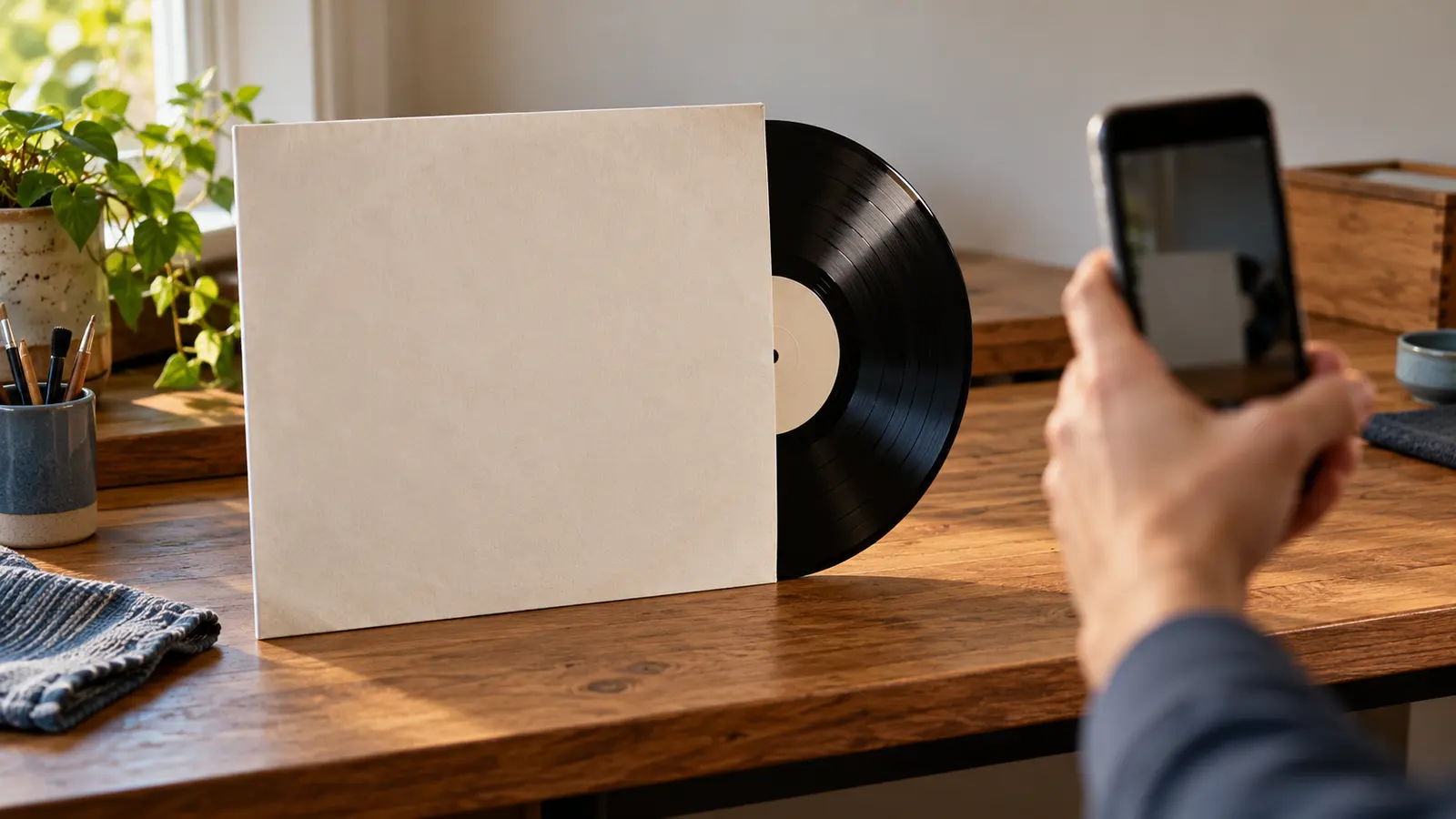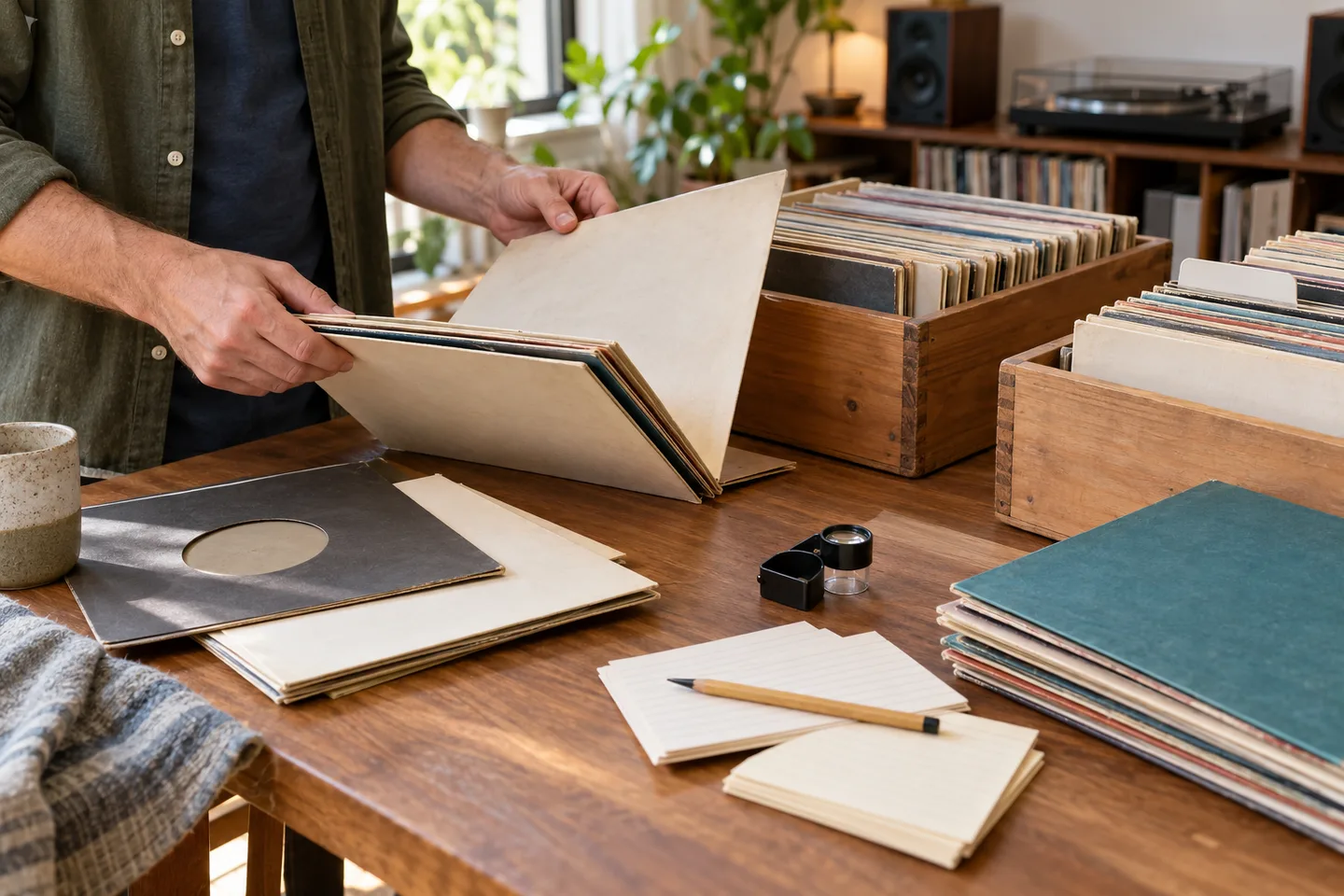
Crate digging works best when you treat every record as an unidentified used object, not as a bargain waiting to be rescued. Set a spending limit, inspect the disc and jacket separately, verify the exact edition, and price the risk of an unplayed copy into your decision. You can make a good buy without guessing that a title is rare or promising yourself a future profit.
The method below is designed for a record fair, shop, flea market, estate sale, or a seller’s table. It gives you a repeatable five-minute process while leaving room for the slower pleasure of finding something unexpected.
Before you leave: make a small field kit
Bring a phone, a short list of wanted titles, a pencil or notes app, and a cloth tote with a rigid base. A small LED flashlight helps reveal hairlines and warps when a stall is dim. A jeweller’s loupe is useful for tiny runout marks, but it is optional; do not press a lens, phone, or fingernail onto the playing surface. Carry a few stiff dividers so you can separate records you have checked from the next section of a crate.
Choose a budget in two parts: a total ceiling for the day and a per-record ceiling. Keep a reserve for an item that is genuinely better documented than the rest. A limit also prevents a long queue, a persuasive seller, or the excitement of a familiar cover from deciding for you. Write down whether your ceiling includes tax, fair fees, or a cleaning sleeve.
Your want list should include the artist, title, format, and any edition clue you care about. “Original copy” is too vague. Note a label, country, catalogue number, year, or barcode you can check. Leave room for an unplanned record, but do not let an unplanned record erase your inspection time.
Start with the jacket, then check the contents
Hold the jacket by its edges and ask permission before removing anything. At a busy table, the seller may prefer to do the handling; follow that instruction. Keep your hands clean and dry. The Library of Congress handling guidance advises handling discs by the edge and centre area, and its care guidance is a useful reminder that careful handling is cheap preservation.
Look at the jacket in good light. Check all seams, corners, spine text, ring wear, water marks, writing, stickers, tape, and cut-out or drill holes. Open the top only as far as needed. A split seam can be repaired or replaced, but it changes the package you are buying. Check whether the inner sleeve, lyric insert, poster, obi, or booklet promised by the edition is present. A clean disc in a damaged sleeve is a different object from a complete set; record the two conditions separately.
Do not assume the disc inside belongs to the jacket. Read the centre label on both sides and compare the artist, title, side designation, and catalogue number. Mis-sleeved records are common enough that this check should happen before any price conversation.
Inspect the playing surface without inventing a grade
Take the record out by the edge and centre label. Never drag it across the jacket or table. Tilt it slowly under one light source. Look for a broad, dull haze, repeated paper scuffs, scratches that cross the grooves, and marks that look like cracks. Rotate the disc to distinguish a line in the vinyl from a reflection. Check the spindle hole for trails and the label for writing, residue, or water damage.
Use the Goldmine terms that buyers and sellers recognise, but use them as descriptions rather than promises. Discogs says its marketplace uses the Goldmine Standard: Near Mint should show no obvious wear; VG+ may have light handling or sleeve marks and should play with minimal noise; VG has more pronounced wear and audible surface noise; Good can have significant noise and visible groove wear. The standard applies to the record and the sleeve as separate grades. A seller’s “excellent” or “plays great” is not a substitute for asking what was actually checked.
Visual inspection cannot reveal every fault. A glossy disc may have groove wear, a pressing defect, or a repeating tick that only appears during playback. A light scuff may be quiet. If the table has an audition turntable, ask to hear the opening, a quiet passage, and the end of a side. Keep the stylus and controls in the seller’s hands if that is their policy. Listen for skips, repeating passages, loud repeating clicks, non-fill-like tearing, and a persistent wash of noise. A short audition is evidence about that copy on that setup, not a guarantee about every track at home.
If there is no turntable, mark the copy as visually inspected only. Do not upgrade a visual VG+ to a play grade in your notes. Ask whether the seller accepts returns for a skip or a materially different condition, and keep the receipt or written agreement.
Verify the exact edition
The cover and title identify an album; they do not identify a release. Read the label design, catalogue number, country, copyright line, barcode, label address, and any text around the rim. Then inspect the dead wax for the matrix or runout on each side. Compare those clues with a reliable release entry or the label’s own catalogue information. Your aim is to establish what the copy is, not to declare it valuable.
Separate four facts in your notes: asking price, any documented sold-price reference, condition, and edition. A seller’s asking price is not a sale. A historical sale for a different pressing or a different grade is not evidence for this one. If the matrix is faint, photograph it without touching the grooves and check it later; do not hold up a queue while guessing at a character.
Use our matrix runout guide, vinyl label identification checklist, and original pressings versus reissues guide to make the comparison systematic. If the release still cannot be confirmed, treat it as an unidentified edition and set a price you are comfortable paying for that uncertainty.
Ask useful questions and negotiate on facts
Good questions are specific: “Has this copy been play-tested?” “Is the sleeve split on the bottom seam?” “Are the inserts complete?” “Can we compare the matrix to the listing?” Avoid asking a seller to certify rarity on the spot. A fair negotiation starts with an observable issue: a split, missing insert, untested side, or mismatch between the jacket and disc.
Make one clear offer and explain the condition that informs it. If the seller has already priced the record accurately, accept the answer and move on. Do not peel stickers, unfold inserts, or open sealed packaging without permission. Sealed is a condition description, not proof of the exact pressing or an assurance that the record is flat and playable.
For online or mail-order purchases, ask for photos of both labels, the runouts, the jacket seams, and any defect. Discogs recommends caution when a listing is dramatically below comparable asking prices and notes that the marketplace cannot physically inspect an item in a grading dispute. Use the platform’s terms, keep messages and photos, and ask for the seller’s return policy before paying.
Know the walk-away cases
Walk away when the disc is cracked, badly warped, or has a scratch you can feel that reaches the playing grooves unless you explicitly want a decorative or parts copy. Leave when water or mould has affected the jacket and inner sleeve, when the record is in the wrong cover and cannot be identified, or when the seller will not let you inspect basic details. Strong smoke or chemical odour is a practical reason to pass; it can transfer to sleeves and other records.
Also walk away from pressure. “Someone else is about to buy it” does not make an unverified pressing safer. If the title is common and the copy is untested, there will be another copy. A record you cannot identify, handle, or return is not a bargain merely because the sticker is low.
Transport the copy home safely
Ask for a stiff mailer or a box if the trip is long. Keep the record upright, away from a hot car window, and do not leave it in a parked vehicle. For a jacket with a seam split, place the disc behind the jacket inside the outer sleeve so its weight does not worsen the split; retain original inner sleeves separately if they are fragile. At home, let a cold record acclimatise before opening a sealed jacket. Store it vertically with support, then log the title, edition clues, media grade, sleeve grade, price paid, and any uncertainty.
DiscSnap can help identify and organise the records you bring home. You can verify the app in the App Store or Google Play, then use your own notes and the physical copy to confirm the edition and condition.
A five-minute table checklist
- Set the copy aside and ask before handling it.
- Check the jacket, seams, inserts, and odour.
- Confirm the disc belongs in that jacket.
- Inspect both sides under one angled light; never touch the grooves.
- Record labels, catalogue number, country, barcode, and runouts.
- Ask whether it was play-tested and audition a quiet passage when possible.
- Keep asking price, condition, edition, and uncertainty as separate notes.
- Make one evidence-based offer, or walk away.
- Carry it upright and log it when you get home.
For a deeper condition reference, compare your notes with our Goldmine grading guide and vinyl sleeve condition guide. The habit that pays off on every dig is simple: identify the exact copy, describe what you actually saw or heard, and let the unknowns lower your confidence before they lower your standards.
Editorial method: This guide synthesizes the Discogs grading and safe-buying guidance cited above with the linked edition, matrix, barcode and bootleg references. The process is editorial guidance, not a timed market visit or firsthand test.