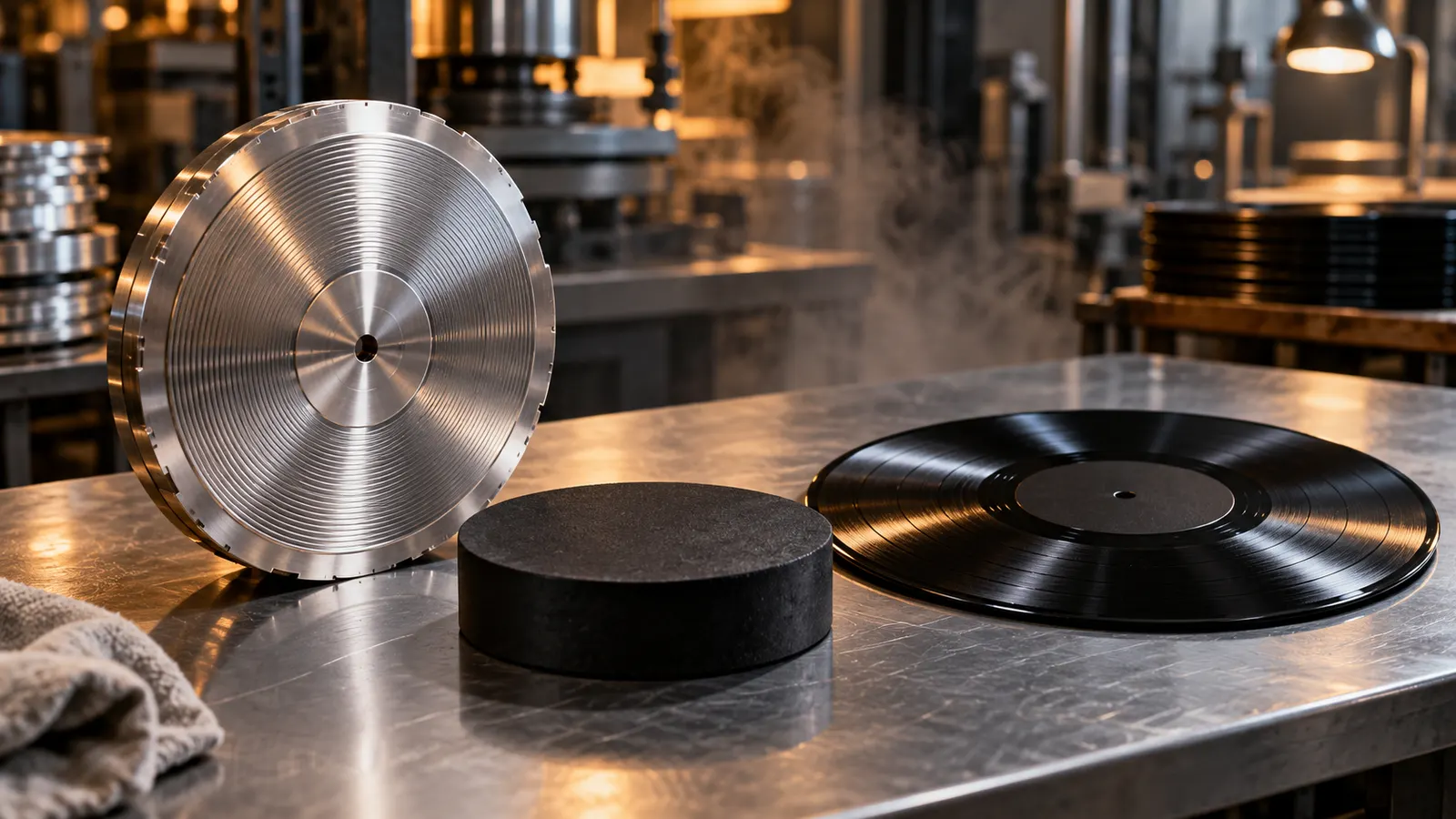
A pressed record is made by transferring a groove into metal, moulding that negative into heated PVC, then cooling, trimming and checking the disc. The audio does not go straight from a digital file into a press. A mastering engineer first cuts each side into a lacquer or uses Direct Metal Mastering (DMM); a plating department turns that cut into metal parts; the press uses a pair of stampers to form the record; and finishing staff inspect and package it. The exact equipment and order vary by plant, but the chain below explains the terms a collector sees on a production schedule or a test pressing.
If you are investigating a copy you already own, begin with the matrix and dead-wax guide. A pressing plant’s name, a mastering inscription and a catalog number can be useful clues, but a mark in the runout is not universal proof of where every copy was made. Treat the physical record, label, sleeve and reliable release documentation as one evidence set.
1. Audio is prepared for a physical groove
The plant receives a supplied master, usually as high-resolution digital audio or an analogue source, together with side breaks, running order and label copy. Vinyl has practical limits: a side that is very long, very loud or heavy in deep bass needs more groove space and may require a different level or a new master. The mastering engineer balances level, bass and sibilance so the stylus can trace the groove without collisions or mistracking.
This is where the phrase “mastered for vinyl” matters. It does not mean that a record is automatically analogue, warm or better than a digital release. It means the source has been prepared for the speed, time and geometry of a record. Ask the label which master was used if that distinction matters to your collection. A plant can press a beautifully made disc from a poor source, and a careful master can still be harmed by a pressing defect.
Record Industry’s plant guide describes two common cutting routes: lacquer cutting and DMM. Its plant page explains that a lacquer has an acetate layer, while a DMM cut is made directly into a copper plate. Both are single-sided, so an LP needs a cut for side A and another for side B. The engineer chooses a route based on the material and the project; neither label is a guarantee of a particular sound.
2. Lacquer or DMM creates the groove master
Lacquer cutting
A lacquer is an aluminium disc coated with a soft lacquer surface. A cutting lathe rotates it while a heated stylus traces the audio signal into a spiral groove. The cut includes the music grooves, the lead-in, the gaps between tracks and the runout area. The lacquer is delicate: dust, scratches or a handling error can damage the source of an entire side, so plants and mastering rooms handle it carefully.
Direct Metal Mastering
With DMM, a stylus cuts the groove into a copper plate instead of a lacquer. Record Industry says the copper surface can go directly into the electroforming stage, so silvering is not needed. DMM and lacquer are different manufacturing routes, not names for different pressing plants. A collector normally cannot identify the route from a generic “Made in” statement alone; look for trustworthy production notes or a documented inscription.
The cutting engineer also creates the information that may later appear in the dead wax. A plant may add a catalog number, side identifier or job code, and a mastering room may add its own signature. These marks can be stamped, etched or absent. Some labels ask for a custom catalog number to be inscribed beside the runout groove, while other projects use codes that make sense only to the plant. Do not assume every visible mark identifies the factory.
3. Electroforming turns the cut into stampers
The cut itself cannot survive thousands of press cycles. In galvanics, the plant coats a lacquer with a conductive silver layer, then grows nickel onto it in an electroforming bath. DMM starts with a conductive copper plate, so nickel can grow directly on the copper. When the nickel shell is separated, it carries a negative image of the groove. Record Industry calls this first negative the father or master.
The plant can grow a positive mother from that negative and then grow a negative stamper from the mother. This father–mother–stamper sequence creates working stampers while retaining an archive or backup part. Some jobs use fewer generations, and terminology differs between plants, so “master,” “mother” and “stamper” should not be treated as interchangeable words. The important practical point is that the stamper is the metal negative that will press the playable groove.
Each record side needs its own stamper. Before it reaches the press, the nickel part is trimmed to fit, drilled for the center spindle and checked for plating faults, blocked grooves or other damage. A single stamper has a working life. Record Industry says one set can press approximately 1,000 to 1,500 records, depending on the job and the plant’s process. A long run may therefore need replacement stampers made from the same metal parts.
4. Labels and a heated PVC puck meet the press
The plant prints and dries the paper labels separately. On a conventional press, the labels are placed on either side of a measured portion of PVC that has been heated and shaped into a short, thick cylinder. Plants call this a puck, biscuit or preform. Record Industry says its vinyl arrives as pellets or granulate, is heated in an extruder and formed under pressure into a puck; the labels are already positioned before it enters the mould.
The recipe can be black PVC, a solid colour or a weighed mixture for a colour effect. The visible appearance may vary between pucks because pellets blend differently. Record Industry’s production support notes that test pressings are commonly black and can have a different weight from the final order, so a white-label test is an audio sample, not necessarily a physical duplicate of the retail edition.
The press closes two heated stampers around the puck. Steam heats the stampers so the softened PVC flows into the microscopic groove walls and around the label recess. Record Industry gives an example of stampers heated to about 180°C and a pressure of about 150 bar for roughly 30 seconds. Those figures describe its process, not a universal setting for every machine, size or weight. A seven-inch, ten-inch and twelve-inch record use different tooling and cycle requirements.
The press forms the center hole and the outer edge at the same time. Excess PVC is squeezed beyond the playing surface as a flash ring. A trimming knife removes that ring to leave the round edge. The trimmings can be collected for recycling or reprocessing according to the plant’s material system, but colour changes and recycled content may be subject to the plant’s specifications. “180 gram” describes the finished weight, not a promise of quieter surfaces or better mastering.
5. Cooling prevents a fresh record from warping
The record leaves the mould hot and still vulnerable to distortion. Mechanical handling moves it into an inner sleeve or a cooling stack. Record Industry describes records cooling flat with a heavy metal spacer inserted after every four records to improve hardening and cooling. Other plants use different stacking, water-cooling or automation arrangements. The shared goal is to let the PVC stabilize while both surfaces remain flat.
Temperature, cycle timing, trimming and storage during this window all affect the finished shape. A record that looked flat on a warm press floor can develop a warp if it is stacked incorrectly or exposed to heat later in transport. A complaint therefore needs to distinguish a manufacturing warp from heat damage in delivery or storage.
6. Test pressings and quality control answer different questions
Before a full run, the plant presses a small number of test copies. Record Industry says its test pressings are supplied with plain white labels, usually three to ten copies, so the customer can approve audio quality and the information inscribed in the mirror. Listen to both sides on a correctly aligned system, check the side order and confirm that the runout text is what the project requested. Keep notes about repeating clicks, non-fill, distortion, skips and loud transitions; one sample cannot predict every copy, but it can catch a major cutting or plating problem before the full run.
Test pressing approval is not the same as a certificate that every retail copy is perfect. Plants sample production, inspect surfaces and verify dimensions, labels, trimming and packaging. Visual inspection can miss a faint click that appears only on a quiet passage, and a transparent or light-coloured record can make pressing defects harder to see. Optimal media’s colour specification warns that some light colours make defects difficult to detect and that surface noise can vary by material and pigment. That is a manufacturing caveat, not a reason to call every coloured record defective.
If a copy arrives noisy, separate the possibilities: dust or a damaged stylus, a dirty record, a pressed-in defect, a warp, a stamper issue or damage after manufacture. Clean and replay it with a known-good setup before making a production claim. Our vinyl storage and cleaning guide covers safe handling, while the Goldmine grading masterclass helps describe audible and visual condition without turning “Near Mint” into a sound guarantee.
What collectors can and cannot infer
You can often infer that a record was pressed from a metal stamper, that its matrix was cut or assigned during production, and that its labels and weight were specified for a job. You cannot infer a plant, mastering engineer or original lacquer solely from a familiar-looking code unless the mark is documented for that release. Plants share equipment, outsource steps and reuse catalogue conventions; a mastering studio’s initials may travel with a lacquer to several plants.
Use the original pressings versus reissues guide when comparing editions, and check the bootleg identification guide if labels, credits, artwork and runouts disagree. Record the exact side A and side B inscriptions, country, label layout, barcode, sleeve details and any pressing notes. DiscSnap can help you identify and organize those records; explore it on iOS or Android, then verify a suggested match against the physical copy.
The plant process gives you a useful map: audio preparation, groove cutting, electroforming, puck pressing, cooling, trimming, testing and inspection. It also gives you a reason to be precise. A record can be an early edition without being from the first stamper, carry a mastering mark without a plant mark, or sound different because of its source rather than its colour or weight. Document what the record actually shows, then make the historical or collecting claim that the evidence supports.
Editorial method: This guide synthesizes Record Industry’s plant documentation and the linked production references, using them to explain a general sequence without assuming every factory uses identical settings. No factory tour, pressing run or listening test was conducted for this article.